On this page
- Workflow 1: Turn Every Episode into Short Clips for Shorts, Reels, and TikTok
- Workflow 2: Run a Secondary Clips Account Across Social Channels
- Workflow 3: Publish Mid-Form Video Cuts to YouTube
- Workflow 4: Send Polished Social Clips to Guests Right After Recording
- Workflow 5: Create Multilingual Video Versions for Global Discovery
- Workflow 6: Turn Episodes or Clips into Blog Posts That Rank
- Workflow 7: Turn Each Episode into a Newsletter
- The Best Podcast Growth System Is the One That Runs Every Week
Recording an episode is the easy part.
The real work starts the moment you hit stop. Every episode you publish triggers a recurring stack of tasks that has nothing to do with the quality of your conversation: clipping highlights, reformatting for vertical video, writing captions, scheduling posts, following up with guests, building show notes, drafting the newsletter. Repeat every week, indefinitely.
That stack is why most podcasts stall. Not because the content is bad, but because the distribution system never gets built. According to eMarketer, there are 121.5 million weekly podcast listeners in the US in 2026, and 71% of podcasters now incorporate video into their shows. More video means more post-production. More post-production means more hours spent on tasks that look identical week after week.
The tasks that repeat with every single episode:
- Reviewing footage and identifying highlight moments
- Clipping and resizing for vertical (Shorts, Reels, TikTok)
- Adding captions and branding to each clip
- Scheduling and publishing across platforms
- Creating mid-form cuts for YouTube
- Sending promo assets to guests
- Writing show notes, blog summaries, and newsletter copy
- Translating or subtitling content for non-English audiences
This is not a content problem. It is an operations problem. The shows that grow consistently are not necessarily recording more often — they have built systems that turn one recording into a distribution engine that runs on its own.
The seven workflows below are the ones worth automating first. Each one maps to a recurring task that currently costs time without scaling. Build them once, and every future episode feeds the machine automatically.
For a campaign that handles episode clipping, captions and publishing on your show’s accounts, see AI podcast clipping with Overlap. Teams configuring their own production pipeline can explore the AI clipping agent platform.
Workflow 1: Turn Every Episode into Short Clips for Shorts, Reels, and TikTok
Short-form clips are no longer a nice-to-have promotional layer for podcasters. They are the primary discovery surface. Podbean's 2026 video podcast report found that YouTube alone had 1 billion monthly podcast viewers by early 2025, with around 70% of all podcast consumers using the platform to watch or listen to shows. New listeners are not finding podcasts through directories first — they are sampling 60-second clips on their feeds, then deciding whether to follow.
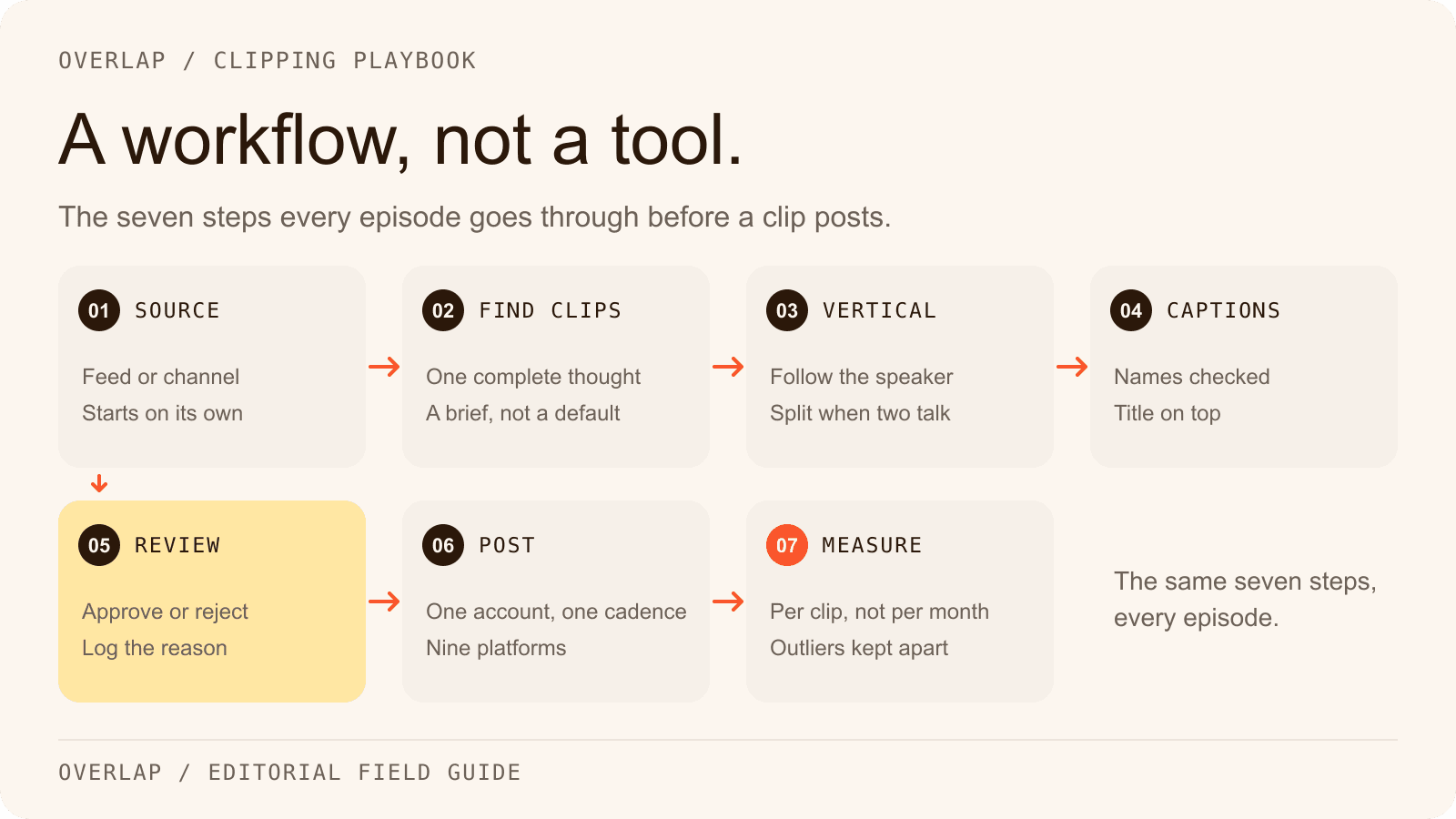
The problem is the manual version of this workflow is brutal. For every episode, a podcaster doing this by hand has to:
- Watch or scrub through the full recording to find strong moments
- Cut each clip to the right length (under 60 seconds for most short-form platforms)
- Reframe the video from landscape to vertical (9:16)
- Add captions, speaker labels, and branding
- Export separate versions optimized for each platform
- Write platform-specific captions and hashtags
- Schedule or manually post to YouTube Shorts, Instagram Reels, and TikTok
That is a multi-hour process per episode. Most podcasters either skip it entirely or do it inconsistently, which means their best content never reaches the audience most likely to discover them.
What the automated version looks like
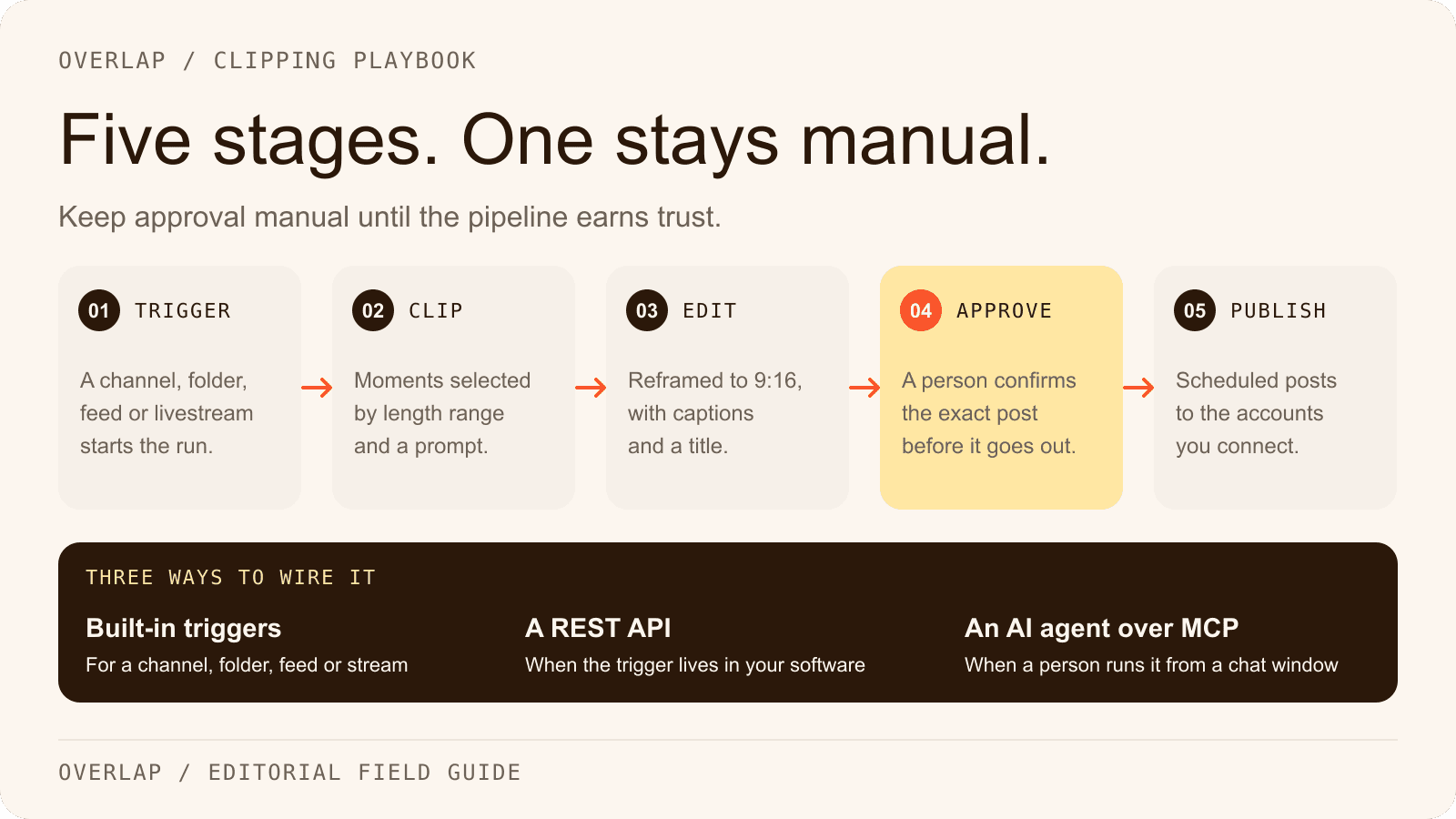
An automated clip workflow detects the upload, identifies high-impact moments using AI, resizes and captions the content automatically, and queues posts across platforms — without anyone reviewing footage manually. Overlap is built specifically for this: agentic workflows that go from raw episode upload to social-ready clips without requiring a human in the loop at each step.
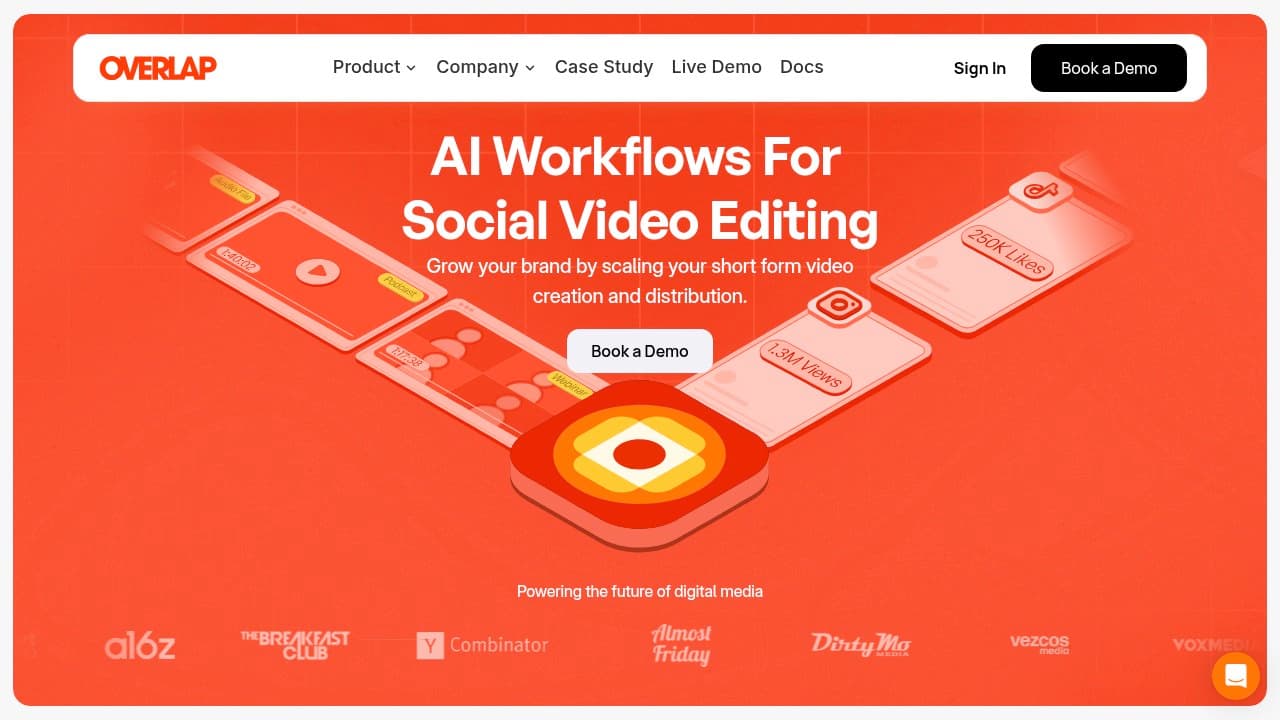
What this workflow should do automatically:
- Detect new episode uploads
- Score and select the strongest moments
- Reframe to vertical with content-aware cropping
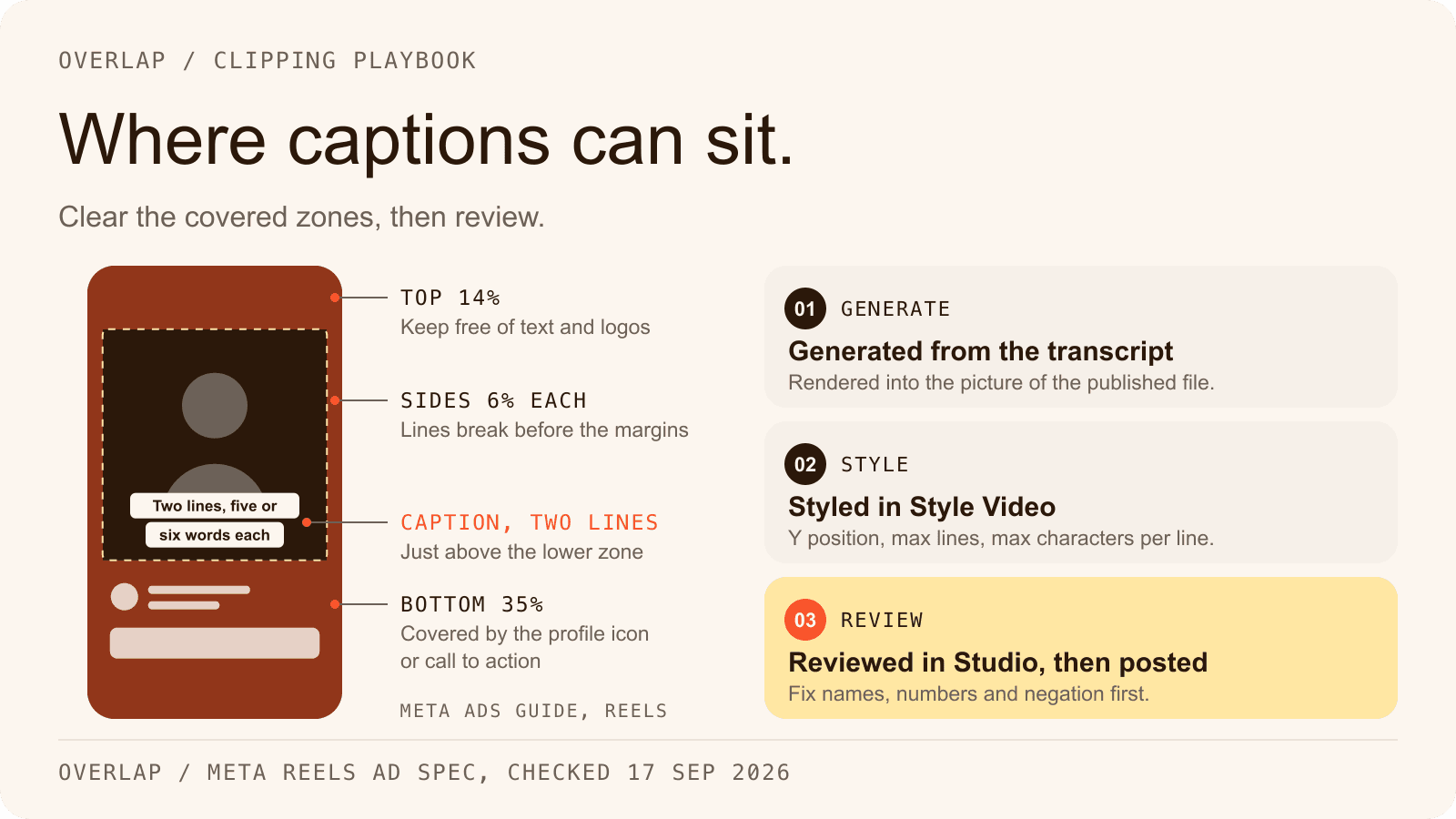
- Generate captions and branded overlays
- Schedule posts across Shorts, Reels, and TikTok at optimal times
The compounding effect matters here. A show that posts five clips per episode, three episodes per month, is publishing 15 pieces of discovery content monthly — without any additional recording. That is the distribution math that separates growing shows from static ones.
Workflow 2: Run a Secondary Clips Account Across Social Channels
Most podcasters treat their main social account as the only distribution channel. That is a strategic constraint, not a requirement. A secondary clips account — a dedicated feed that publishes nothing but episode highlights — lets you post at higher frequency without overwhelming your primary audience with content they did not subscribe for.
The use cases are more specific than they sound:
- Guest highlight accounts: A feed dedicated to "best moments" from every guest interview
- Topic-based channels: A clips account organized around a recurring theme (e.g., "founder stories" or "marketing breakdowns")
- Fan or community accounts: A separate handle that functions as a highlights reel for existing subscribers
The bottleneck that kills this idea before it starts is volume management. Running a secondary account manually means duplicating the entire clip selection, captioning, and scheduling process for a second destination. For a solo podcaster or a team of two, that is not realistic.
Why automation makes this viable
iHeart used Overlap to solve exactly this problem at scale. They activated automated clipping agents across hundreds of shows, revived dormant social channels, and launched a brand-new TikTok highlight account that grew from zero to 19,500 followers in two months — with no human involvement in editing or publishing. That account generated over 68 million impressions, with individual clips reaching 2.6 million views.
The result: 151 million+ views across platforms in under two months, without increasing headcount.
The same model applies at the individual podcast level. A workflow that automatically routes clips to a secondary account — with separate captions, posting schedules, and branding — turns what used to be a two-person job into a system that runs in the background. The secondary account builds its own audience, which eventually feeds back to the main show.
Workflow 3: Publish Mid-Form Video Cuts to YouTube
Not every strong episode moment fits in 60 seconds, and not every viewer wants to watch a full two-hour interview. Mid-form cuts — segments running anywhere from 5 to 20 minutes — occupy a valuable middle ground that most podcasters leave completely empty.
This matters for a specific reason: YouTube is the world's second-largest search engine, processing over 500 million daily search queries. Long-form YouTube videos rank for 3.2 times more keywords on average than short-form content. A standalone 10-minute segment on a specific topic can rank independently for search terms the full episode would never surface for.
| Format | Primary Purpose | Avg. Discovery Method | SEO Value |
|---|---|---|---|
| Full episode | Depth and loyalty | Subscribers, RSS | Low (too broad) |
| Mid-form cut (5-20 min) | Topic-specific search | YouTube search, suggested | High |
| Short clip (under 60s) | Top-of-funnel reach | Algorithmic feed | Low (no indexing) |
The reason most podcasters skip mid-form cuts is not because they do not see the value. It is because trimming a two-hour episode into a coherent 10-minute segment, adding a title card, writing a description, and uploading it to YouTube is another multi-step process on top of everything else that already needs to happen.
Making it automatic
An automated workflow can identify natural topic segments within an episode, extract them as standalone videos, generate titles and descriptions optimized for search, and queue them for YouTube publishing. Overlap's workflow automation handles the segmentation and formatting step, so a single episode upload can produce both short clips and mid-form cuts in the same pipeline. The mid-form channel becomes a compounding search asset — each video a permanent entry point for new listeners finding the show through a specific topic.
Workflow 4: Send Polished Social Clips to Guests Right After Recording
Guest sharing is one of the highest-leverage growth tactics in podcasting because it borrows an audience that already trusts the person sharing. When a guest posts a clip from their appearance, they are not just promoting your show — they are endorsing it to a pre-qualified audience who already respects their judgment.
The problem is that most shows waste this opportunity entirely. Clips get delivered days after recording, if at all. By then, the guest has moved on, the episode feels old, and the social window has closed.
The workflow that actually converts
The sequence needs to happen fast — ideally within 24 hours of recording:
- Episode upload triggers clip generation — AI identifies the guest's strongest moments automatically
- Clips are formatted and branded — vertical cuts with captions, ready to post without any editing from the guest
- A delivery package is assembled — 3 to 5 clips, suggested caption copy for each, and platform-specific sizing
- Package is sent to the guest — via a shareable link or direct delivery, with a short note explaining what is included
- Guest posts from their own account — with zero friction because the assets are already ready to go
The key detail is friction. Guests who want to share but have to edit, resize, or write their own captions rarely follow through. When the package arrives ready to post, the share rate goes up significantly. Research from PodcastVideos.com confirms that frictionless guest distribution is a cornerstone of rapid podcast growth — because it extends reach through pre-validated audience trust without any additional content creation.
With an automated workflow, this process runs the same way every time, for every guest, without a producer manually cutting clips and sending emails after each recording session.
Workflow 5: Create Multilingual Video Versions for Global Discovery
Most English-language podcasters are leaving the majority of YouTube's audience completely untouched. According to Deloitte's 2026 podcast report, the global average for weekly podcast listening sits around 22%, with markets like Indonesia (42.6%) and Mexico (41.8%) leading the world in listenership rates. Meanwhile, 65% of all YouTube watch time comes from outside the United States.
Key stat: Dubbed video content generates +45% views on average compared to English-only versions, according to data from AIR Media-Tech across a network of 3,000 YouTube channels. Subtitles alone increase views by 7.32%.
The reason most shows have never attempted multilingual distribution is cost and complexity. Professional dubbing used to require hiring translators, voice actors, and audio engineers for each language. That math only worked for large media companies.
What changed
AI dubbing and localization tools have collapsed that barrier. YouTube now offers auto-dubbing in 20+ languages for Partner Program channels. Dedicated workflow tools can translate, dub, and publish localized versions of clips automatically. The result: the same clip can appear in Spanish, Portuguese, and French feeds without any additional recording or manual production.
What a multilingual clip workflow should include:
- Auto-translation of captions and metadata (titles, descriptions, tags)
- AI dubbing or subtitle generation in target languages
- Routing to language-specific channels or accounts where applicable
- Translated metadata that creates new keyword surface area in each language
The SEO implication is significant. A clip with Spanish subtitles becomes discoverable to Spanish-language search queries. Add Portuguese and French, and the same piece of content now ranks in three separate keyword markets where competition is lower than in English. Localization is not just a reach play — it is a search strategy that compounds over time.
Workflow 6: Turn Episodes or Clips into Blog Posts That Rank
Social clips drive discovery in the moment. Blog posts drive discovery for months and years afterward. A well-structured article based on an episode topic can rank on Google for relevant search queries long after the episode itself has been forgotten by the algorithm.
The distinction that matters here: a transcript is not a blog post. Dumping a raw transcript onto a page creates an unreadable wall of text that neither search engines nor readers find useful. The workflow that actually generates SEO value extracts the structure from the conversation — the argument, the key takeaways, the supporting examples — and rebuilds it as a searchable article.
Before automation vs. after automation
Without a workflow:
- Episode is published to RSS and audio platforms
- Show notes are brief or missing
- No written asset exists for the topic
- The episode is invisible to anyone searching Google for that subject
With an automated blog workflow:
- Episode transcript is processed and structured automatically
- Key themes, quotes, and takeaways are extracted
- A draft article is generated with headers, formatting, and SEO-ready copy
- The episode topic now appears in search results for relevant queries
According to enTICEing Media, 94% of marketers now repurpose content across channels, and a single podcast episode can realistically become a summary blog, a newsletter, quote graphics, and multiple social posts — often 10 to 15 distinct assets from one recording. The blog post is the highest-leverage written asset in that stack because it compounds over time.
For solo podcasters, this workflow eliminates the need to hire a content writer. For small teams, it removes the weekly bottleneck of writing show notes and long-form content from scratch. The episode does the work — the workflow turns it into something that ranks.
Workflow 7: Turn Each Episode into a Newsletter
Social platforms control who sees your content. Email does not. A newsletter built around each episode creates a direct line to your most engaged audience — one that does not depend on an algorithm deciding whether to show it.
The problem is that writing a newsletter feels like the last task anyone wants to do after editing, publishing, and promoting an episode. So most shows either skip it entirely or send a bare link with a two-line description that nobody clicks.
The right newsletter format is not a transcript summary or a "new episode" announcement. It is a short editorial piece that gives subscribers a reason to engage even if they have not listened yet.
A repeatable newsletter structure for every episode
- Subject line: A specific insight or question from the episode (not "New episode out now")
- Opening hook (2-3 sentences): The most interesting idea from the conversation, stated plainly
- Key takeaways (3-5 bullets): The specific things a reader would learn from listening
- One standout quote: A single line from the guest or host that earns a click
- Listen link + short CTA: One clear action, not three
This structure can be generated automatically from an episode transcript. AI can extract the core argument, pull the strongest quotes, and format a first-draft newsletter that requires minimal editing before sending. Distribution.ai's 2026 repurposing guide confirms that AI tools can now restructure podcast transcripts into newsletter features and social snippets reliably enough to use as working drafts.
The result is owned distribution that grows with the show. Every subscriber who signed up because of a clip on TikTok becomes a direct contact who gets value from the show every week — without needing to remember to open a podcast app.
The Best Podcast Growth System Is the One That Runs Every Week
The goal of automating these workflows is not efficiency for its own sake. It is consistency. The shows that grow are the ones that distribute reliably — not the ones that have a great week followed by three weeks of nothing because the post-production backlog got out of hand.
Each of the seven workflows above targets a recurring task that currently resets every episode. Automate one and you recover hours. Automate the stack and you build a distribution engine that scales with your output, not your calendar.
The compounding logic:
- Short-form clips create top-of-funnel discovery across three platforms
- Secondary accounts expand reach without diluting the main feed
- Mid-form YouTube cuts build a permanent search presence
- Guest clip packages turn every interview into a shared promotion
- Multilingual versions open non-English markets with the same content
- Blog posts create evergreen discoverability that outlasts any algorithm
- Newsletters convert passive listeners into an owned audience
Most tools in this space solve one of these problems. They make clipping faster, or captioning easier, or scheduling more convenient. That is useful, but it does not change the operational model. The bottleneck is not any single task — it is the fact that every episode triggers the entire stack, every time.
Overlap is built to automate the full workflow rather than individual steps. From episode upload to clip generation, distribution, and social publishing — the platform is designed so that one upload triggers the entire pipeline automatically, across every channel and format you have set up.
If you are a solo podcaster or running a small team, that is the difference between a show that grows and a show that stays flat. The content is not the constraint. The workflow is.
Ready to stop rebuilding the same process every week? See how Overlap works for podcast teams.