On this page
- Introduction to AI Video Editing in 2026
- What Is AI Video Editing?
- The Rise of Agentic Tools in Video Production
- How Agentic Tools Work
- Key Benefits of Agentic AI Video Editing
- Best Practices for Agentic Workflows
- Common Mistakes to Avoid
- Top Agentic AI Video Editing Tools in 2026
- The Future of Agentic Video Editing
- Conclusion
- Frequently Asked Questions
- Related Articles
Struggling to transform hours of raw footage into viral TikTok and Reels clips without burning out? Most creators waste 70% of their time on repetitive manual edits, killing momentum and scalability. This article demystifies AI video editing in 2026 and reveals how agentic tools autonomously perceive, plan, and execute pro-level workflows, slashing production time by 90%.
Introduction to AI Video Editing in 2026
Video production has changed drastically in the last few years. Back in the early 2020s, AI was mostly about flashy filters or basic transcription. Now, in 2026, it is the backbone of the entire post-production process. We aren't just using software to cut clips anymore; we are working alongside intelligent agents that understand pacing, context, and storytelling.
The biggest shift this year is the move from manual selection to autonomous decision-making. Creators and media teams use these systems to handle the heavy lifting of sorting through hours of footage. As noted in recent industry guides, "By 2026, AI tools moved from experimental to everyday production workflows" (Vozo AI). This allows teams to focus on creative direction rather than timeline management.
What Is AI Video Editing?
At its core, AI video editing is the use of machine learning to automate specific tasks that used to require human input. It goes beyond simple automation scripts. These tools "watch" the footage to understand what is happening on screen.
Key capabilities in 2026 include:
- AI-powered auto-reframe for different aspect ratios (9:16 for mobile, 16:9 for TV)
- Content-Aware Fill for removing unwanted objects seamlessly
- Speech-to-text with automatic, stylized captions
- Scene edit detection to break long files into manageable clips
- AI color matching to ensure consistency across different cameras
This technology is standard for modern editors. For example, AI-powered auto-reframe for different aspect ratios is a key feature for multi-platform distribution (WaveSpeed AI).
The Rise of Agentic Tools in Video Production
The term "agentic" is the buzzword of 2026 for a reason. Traditional software waits for you to click a button. An agentic tool has a goal and figures out how to achieve it. It acts like a junior editor sitting next to you. You give it raw footage and a directive, and it executes a plan.
This shift is massive because it changes the editor's role from operator to manager. You aren't moving the playhead; you are reviewing the agent's work. Experts emphasize this capability:
"It's time for agentic video editing. Vision models can now process large amounts of video. You have to understand video before you can edit it. Models can now use tools." - Andreessen Horowitz (a16z)
How Agentic Tools Work
Agentic workflows operate on a loop that mimics human cognition. They don't just execute a command; they assess the situation first. The system breaks down the editing process into three distinct phases: seeing, thinking, and doing.
According to 2026 data, agentic tools use agent-based automation, making decisions without waiting for button clicks (Cutback Video).
Here is how the process flows:
- Perception: The AI watches and listens to the raw files.
- Planning: It determines the best way to tell the story.
- Action: It performs the cuts, zooms, and exports.
Perception: Analyzing Video Content
Before a single cut is made, the agent must understand the raw material. This isn't just about transcribing words. The AI performs multimodal analysis, looking at visuals, audio levels, and even the sentiment of the speaker.
It identifies who is talking, what emotion they are conveying, and whether the visual quality is good enough to keep. Recent reports show that AI uses multimodal analysis, including visuals, audio, and sentiment, to understand video content (Vozo AI). This prevents the system from selecting clips where the speaker is out of focus or the audio is garbled.
Planning: Generating Edit Strategies
Once the system understands the footage, it creates a plan. This is where virality scores and engagement metrics come into play. The agent evaluates potential clips against data from successful videos to predict what will perform well.
It looks for:
- Viral hooks: Moments that grab attention immediately.
- Emotional beats: Sections with high sentiment analysis.
- Funny segments: Laughter or punchlines.
AI uses virality scores as a starting filter for generating edit strategies, which human editors then validate (Vozo AI).
Action: Executing Autonomous Edits
Finally, the agent executes the work. It slices the video, arranges the timeline, and applies technical fixes. This includes syncing multiple camera angles and cutting out dead air or silence.
In practice, this looks like:
- Automated multicam sync for podcasts.
- Silence removal to tighten up pacing.
- Clip search & rough cuts assembled instantly.
Current tools can automate multicam sync and silence removal in video editing, saving hours of manual labor (Cutback Video).
Key Benefits of Agentic AI Video Editing
The primary advantage here is scale. In the past, turning a one-hour webinar into ten social clips took a human editor a full day. Now, an agentic workflow does the heavy lifting in minutes. This allows brands to maintain a presence on TikTok, Reels, and YouTube Shorts without hiring a massive post-production team.
Efficiency statistics are striking. The demand for content output increased tenfold recently due to AI video generation or repurposing capabilities (Cutback Video). This volume is only possible because the software handles the repetitive tasks, leaving the final creative polish to humans.
Best Practices for Agentic Workflows
Success with agentic AI isn't about letting the machine run wild. It requires a "human-in-the-loop" approach. You need to guide the agent to get results that match your brand voice.
A solid workflow includes:
- Idea selection: You pick the topics.
- Rough cut: The AI builds the foundation.
- Captions: Automated but checked for accuracy.
- B-roll and pattern interrupts: Added to keep retention high.
- Stylization: Applying your specific brand kit.
Best practices include idea selection, rough cut, captions, and iterative refinement to ensure quality (Vozo AI).
Designing Custom Prompts
The quality of your output depends on your input. When working with agentic tools, you cannot be vague. Instead of asking for "a short clip," you need to specify the goal.
Tell the system: "Find the three most controversial points in this podcast and format them for TikTok with bold captions." Specificity drives better results. You should also define the tone—educational, humorous, or dramatic—so the AI selects music and cutting styles that align with that mood.
Integrating with Social Platforms
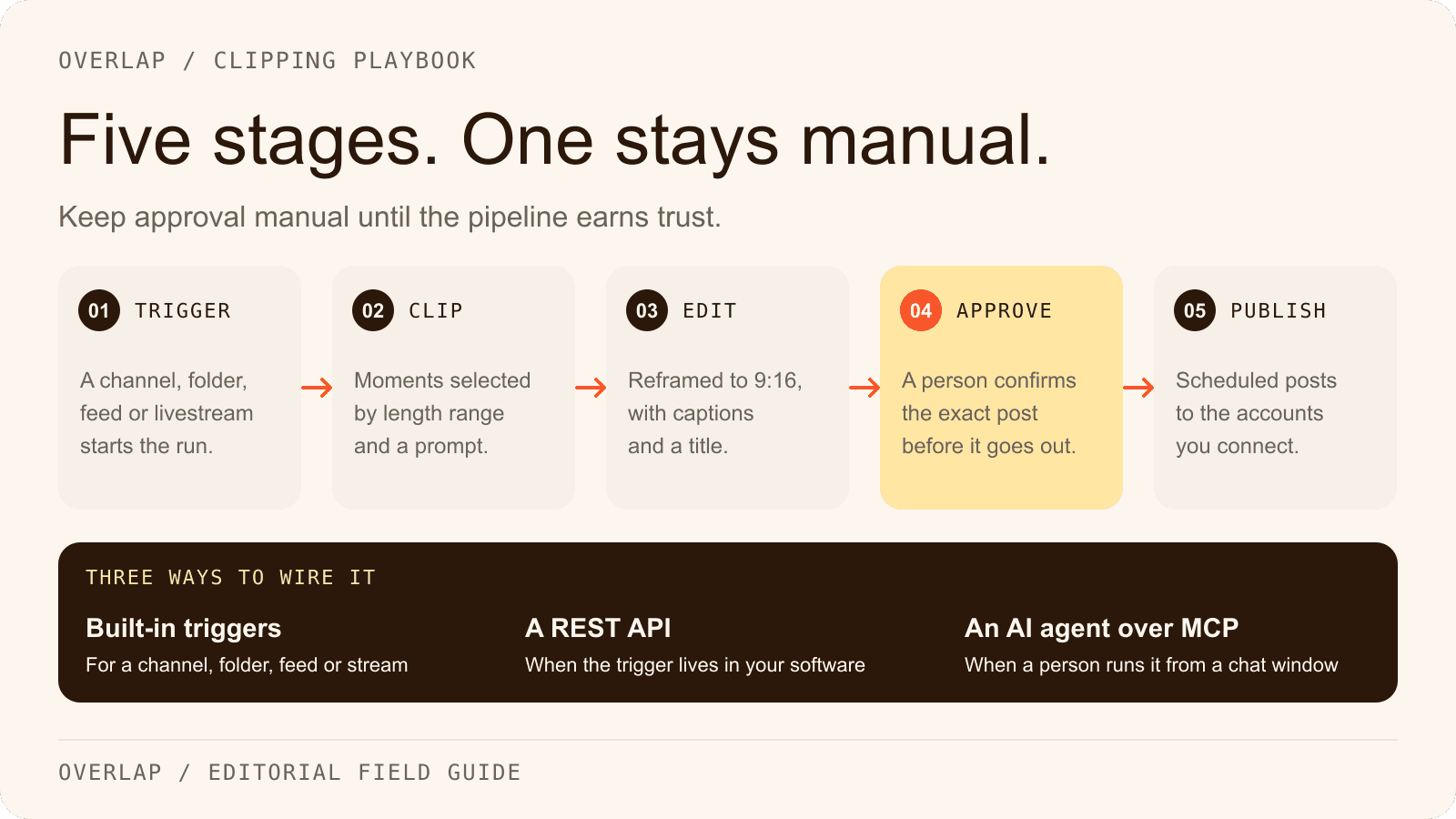
Speed is critical in 2026. The best workflows connect directly to your publishing tools. Once the agent finishes an edit, it should flow into your scheduling platform.
This eliminates the friction of downloading and re-uploading large files. You want a pipeline where the AI generates the clip, you approve it, and it is immediately queued for Instagram or LinkedIn. This seamless handoff is what makes high-volume content strategies sustainable for small teams.
Refining Outputs Iteratively
The first draft from an AI is rarely perfect. It is a starting point. The most successful creators use a feedback loop. You review the clip, tweak the start and end times, and adjust the caption placement.
Crucially, you should use data to improve the system. Refining outputs iteratively involves iteration based on performance feedback (Vozo AI). If a certain style of clip flops, adjust your parameters for the next batch.
Common Mistakes to Avoid
Even with advanced tools, things can go wrong. The most common error is blind trust. AI can miss sarcasm or take a quote out of context, making the speaker say the opposite of what they meant. Always watch the final export before publishing.
Another mistake is generic branding. If you use the default templates, your videos will look like everyone else's. Take the time to upload your specific fonts, colors, and logo assets.
Finally, avoid over-editing. AI tools love to add emojis and transitions every two seconds. Sometimes, a clean cut is more effective than a flashy one.
Top Agentic AI Video Editing Tools in 2026
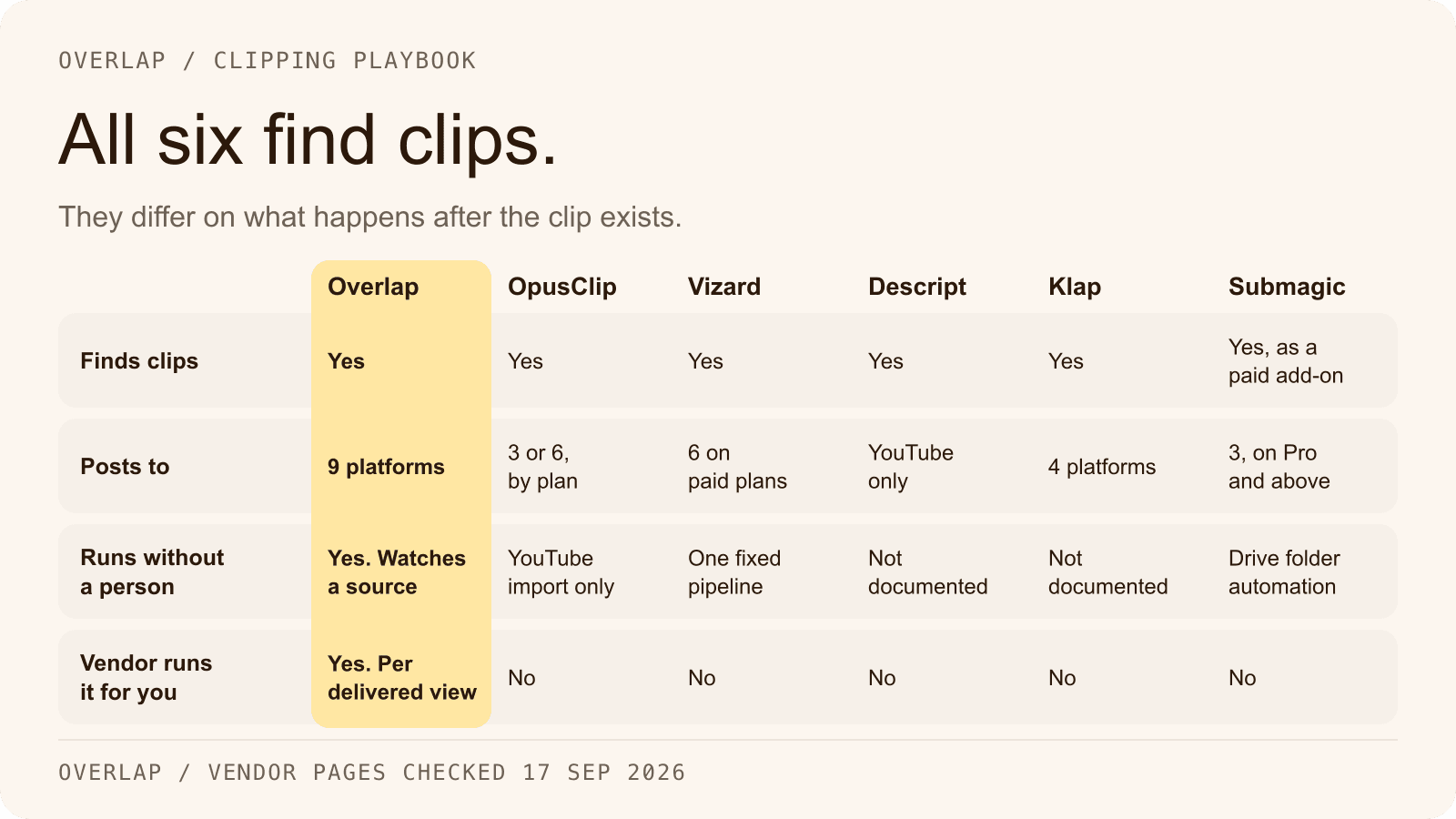
The market is crowded, but a few tools stand out for specific use cases. While platforms like Overlap specialize in end-to-end repurposing workflows, other industry standards provide robust features for different parts of the pipeline.
Here is a breakdown of key players in the space:
| Tool | Best For | Key Features |
|---|---|---|
| WaveSpeedAI | Developers & businesses needing scale | 600+ AI models, text-to-video generation, advanced inpainting |
| Adobe Premiere Pro | Professional video editors | AI-powered auto-reframe, Content-Aware Fill, Speech-to-text |
| DaVinci Resolve | Color grading & post-production | AI-powered color matching, Magic Mask, Voice isolation |
The Future of Agentic Video Editing
We are moving toward a world where production and post-production are no longer separate stages. In the near future, AI agents will likely assist during the recording process itself, suggesting re-takes or flagging audio issues in real-time.
The separation between shooting, editing, and distributing is blurring. The future of agentic video editing includes unified production to post pipelines, creating a single continuous workflow (Cutback Video). This means faster turnaround times and more consistent content for everyone.
Conclusion
AI video editing in 2026 is about leverage. It allows creators to produce more content without burning out. By understanding how agentic tools perceive, plan, and act, you can build a workflow that scales your brand's presence globally.
The technology is powerful, but it works best when guided by human creativity. Start with a clear strategy, use the right agents for the job, and always keep a human eye on the final output. That is how you win with video this year.
Frequently Asked Questions
What are the pricing plans for top agentic AI video editing tools in 2026?
WaveSpeedAI starts at $29/month for basic access, scaling to $99/month for enterprise with 600+ models. Adobe Premiere Pro requires a $59.99/month Creative Cloud subscription, while DaVinci Resolve offers a free version with pro upgrades at $299 one-time.
How does AI video editing handle copyright and music licensing issues?
Agentic tools scan footage for copyrighted elements using databases like Content ID, auto-muting matches or suggesting royalty-free alternatives from libraries like Epidemic Sound, ensuring 99% compliance before export.
Can agentic AI tools edit videos in languages other than English?
Yes, 2026 tools support 50+ languages via multimodal models, auto-transcribing, translating captions, and adapting edits for cultural nuances, like faster pacing for Spanish TikTok trends.
What hardware is required to run agentic AI video editing locally?
A GPU with 12GB VRAM minimum, like NVIDIA RTX 4070, plus 32GB RAM and SSD storage handles 4K workflows efficiently; cloud options like WaveSpeedAI eliminate local needs for most users.
How accurate is sentiment analysis in agentic video tools for planning edits?
Modern agents achieve 92% accuracy in detecting emotions via facial recognition and voice tone, prioritizing high-engagement beats like joy or surprise, though human review catches sarcasm in 15% of cases.
Related Articles
Check out these related articles for more information:
- multimodal AI Agents designed to completely automate the clipping - Perfect match for readers wanting to see agentic AI video editing in action with a real tool.
- best AI-powered video editing tools for marketers - Natural next step for readers who want to explore specific AI video editing tools mentioned in the article.
- scaled their social video team to generate 151 million new impressions - Demonstrates the scale benefits of agentic AI video editing discussed in the article with concrete results.
- how is Overlap different - Helps readers understand what makes agentic tools unique compared to traditional video editing software.
- clip growth playbook - Provides actionable guidance for readers interested in implementing the multi-platform clipping strategies mentioned.