On this page
- The Short-Form News Audience Is Not Coming Back to Your Website
- What AI Clipping Actually Changes for Newsrooms
- Building an AI Clipping Workflow for Your Newsroom
- Why Overlap Is Built for Newsroom Clipping Workflows
- Short-Form Video Distribution: The Metrics That Actually Matter
- Common Objections (And Why They Don't Hold Up)
- The Newsroom Clipping Playbook for 2026
- Key Takeaways
The audience has already moved. According to Pew Research, 1 in 5 U.S. adults now regularly get their news on TikTok, up from just 3% in 2020. Among adults under 30, that number hits 43%. Meanwhile, Instagram and TikTok together account for 82% of total social engagement for news publishers, with Facebook and X sharing the scraps.
The platforms have changed. The audience has changed. The one thing that hasn't changed fast enough is the newsroom workflow.
Most newsrooms are still treating video clipping as an afterthought: a post-production task assigned to a junior editor, done manually, hours after a broadcast wraps. The result is a 90-second clip posted to Instagram the next morning, long after the moment has passed and the algorithm has moved on.
The real problem: clipping isn't a production task. It's a distribution strategy. And in 2026, newsrooms that haven't automated it are leaving their most engaged audience on the table.
This guide breaks down exactly how newsrooms should be thinking about AI clipping in 2026, what a modern short-form video distribution workflow looks like, and how to build one that scales without burning out your team.
The Short-Form News Audience Is Not Coming Back to Your Website
There's a stubborn assumption in traditional newsrooms: that social video is a funnel, a way to drive viewers back to the broadcast, the app, or the website. The data says otherwise.
Reuters Institute research shows that people access short news videos primarily through social platforms, not publisher websites. Two-thirds of those surveyed access short news videos every week, and the majority of that consumption happens natively on TikTok, Instagram, and YouTube, not via links clicked through to an external destination.
What this means for newsrooms: the clip IS the content. It's not a teaser. It's not a trailer. For a growing segment of the news audience, a 45-second Reel or a 60-second Short is the entire news experience they want from your organization.
The Scale of the Shift
The numbers are hard to ignore:
- YouTube Shorts now averages 200 billion daily views, up 186% from 70 billion in March 2024
- Instagram Reels crossed a $50 billion annual run rate as of Q3 2025 (Meta earnings)
- 87.5% of online adults watch short-form video every week
- 88% of the Daily Mail's total social engagement is now driven by TikTok, despite being a legacy print outlet
The Daily Mail number is the one worth sitting with. A 130-year-old print newspaper generates 88% of its social engagement from short-form video on a single platform. That isn't a social media strategy. That's an audience reality.
Why Legacy Newsrooms Are Falling Behind
The gap between audience behavior and newsroom output isn't a creativity problem. It's an operational one. Traditional broadcast and digital newsrooms were built for a linear production model: report, edit, publish, archive. Short-form video distribution requires a parallel, always-on production layer that most newsrooms simply don't have the staffing or tooling to support manually.
The result is a predictable pattern:
- A major story breaks during a live broadcast
- The best moments are buried in a 22-minute segment
- A clip is manually cut the next day, if at all
- It's posted once, to one platform, without platform-specific formatting
- Engagement is low; the team concludes "our audience doesn't respond to short-form"
The conclusion is wrong. The workflow is the problem.
What AI Clipping Actually Changes for Newsrooms
Manual clipping at scale is arithmetically impossible. A 30-minute evening broadcast, a 45-minute press conference, and a 20-minute long-form interview all happening on the same day represent roughly 95 minutes of raw footage. Manually identifying the best moments, cutting them, reformatting for vertical, adding captions, and publishing across three platforms could take a skilled editor four to six hours. That's before the next day's content arrives.
AI clipping collapses that timeline to minutes.
What the AI Actually Does
Modern AI clipping isn't just auto-cutting. The best platforms analyze footage across multiple dimensions simultaneously:
- Semantic analysis: identifying high-information-density moments (key quotes, breaking information, emotional peaks)
- Engagement prediction: scoring moments based on patterns that drive retention and watch time
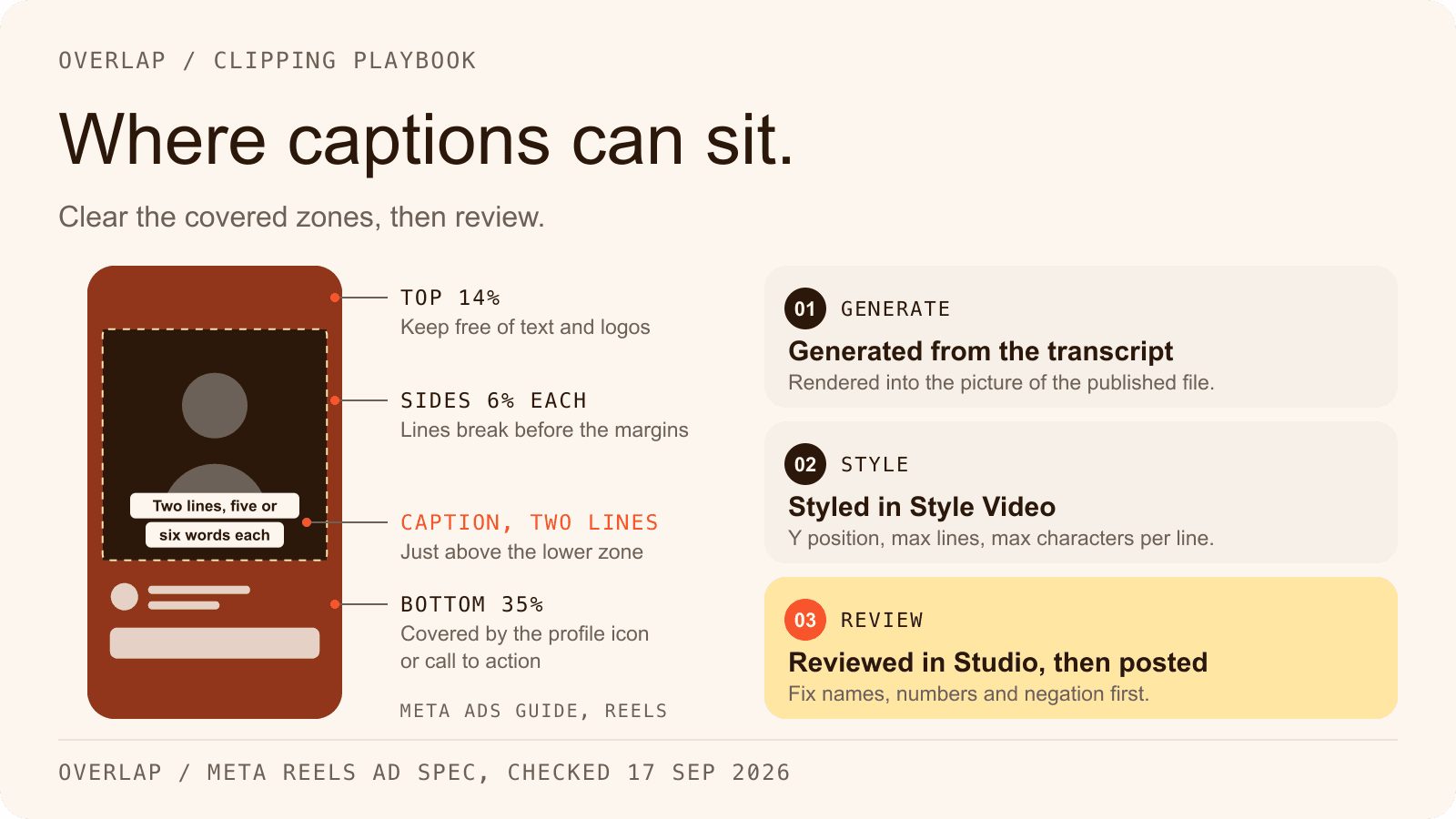
- Auto-transcription and captioning: generating platform-ready captions, since around 85% of short-form viewers watch with sound off
- Smart reframing: converting 16:9 broadcast footage to 9:16 vertical automatically
- Platform-specific formatting: outputting different aspect ratios and clip lengths for TikTok, Reels, and Shorts in a single pass
The practical result: a 30-minute broadcast segment can generate 8 to 15 platform-ready clips in the time it takes an editor to log in and review them.
The Human Role Doesn't Disappear
The right way to think about AI clipping in a newsroom context is not "AI replaces editors." It's "AI does the labor, editors apply judgment."
Newsrooms deal with content that requires editorial discretion: sensitive footage, legal considerations, accuracy checks, and brand voice. AI surfaces the candidates; journalists and editors make the final calls. This hybrid model is where the real productivity gain lives, not in removing humans from the loop, but in removing the hours of manual scrubbing that precede every editorial decision.
The workflow shift: Instead of "find the clip, then edit it," the workflow becomes "review the AI's clip shortlist, approve and publish." That's a fundamentally different job, and a much faster one.
Building an AI Clipping Workflow for Your Newsroom
The difference between newsrooms that win on short-form and those that don't isn't talent or resources. It's whether clipping is treated as a system or a task. Here's what a functional, scalable AI clipping workflow looks like in 2026.
Step 1: Ingest and Catalog Raw Footage
Every piece of long-form content, broadcasts, press conferences, field interviews, panel discussions, should feed into a central content library as soon as it's captured. The AI workflow starts here. Without a reliable ingestion pipeline, clipping becomes reactive and inconsistent.
What to automate at this stage:
- Automatic upload from editing suites or broadcast systems
- Metadata tagging (date, story category, reporter, segment length)
- Transcript generation for searchability
Step 2: AI-Driven Moment Identification
Once footage is ingested, the AI scans for high-potential moments using a combination of transcript analysis, audio peaks, and engagement modeling. This is where the shortlist is generated.
For a newsroom, high-potential moments typically include:
- Strong quotes from officials, experts, or subjects
- Breaking information delivered with clarity and impact
- Emotional moments that carry standalone narrative weight
- Data reveals or visual evidence that stands alone without context
The AI ranks these by predicted engagement and presents them as a reviewable shortlist, not a finished product.
Step 3: Editorial Review and Approval
This is the human checkpoint. An editor reviews the AI's shortlist, applies news judgment (is this accurate? is this appropriate to clip out of context?), trims start and end points if needed, and approves clips for publishing. In a well-configured workflow, this step takes 10 to 20 minutes for a full broadcast's worth of content.
Step 4: Platform-Specific Formatting
Approved clips are automatically formatted for each distribution channel. This isn't just aspect ratio conversion; it includes:
| Platform | Optimal Length | Format | Key Consideration |
|---|---|---|---|
| TikTok | 30-90 seconds | 9:16 vertical | Hook in first 2 seconds |
| Instagram Reels | 30-60 seconds | 9:16 vertical | Captions critical |
| YouTube Shorts | 60-180 seconds | 9:16 vertical | Searchable titles matter |
| X (Twitter) | 30-60 seconds | 16:9 or 1:1 | Breaking news context |
| 60-90 seconds | 1:1 or 16:9 | Professional framing |
One approved clip generates five platform-ready versions automatically. No manual resizing, no re-export.
Step 5: Scheduled Distribution
Clips are scheduled across platforms based on audience behavior signals, not manual guesswork. Peak engagement windows differ by platform and by news category. An AI-powered scheduling layer handles this automatically, ensuring clips hit feeds at optimal times rather than whenever an editor happens to be available.
Step 6: Performance Analytics and Feedback Loop
Every clip's performance data, retention rate, watch time, saves, shares, feeds back into the workflow. Over time, the AI learns which story types, clip lengths, and hook styles perform best for your specific audience. The workflow gets smarter with every publish cycle.
The compounding effect: newsrooms that run this workflow consistently don't just publish more. They publish better, because the feedback loop continuously refines what gets surfaced and approved.
Why Overlap Is Built for Newsroom Clipping Workflows
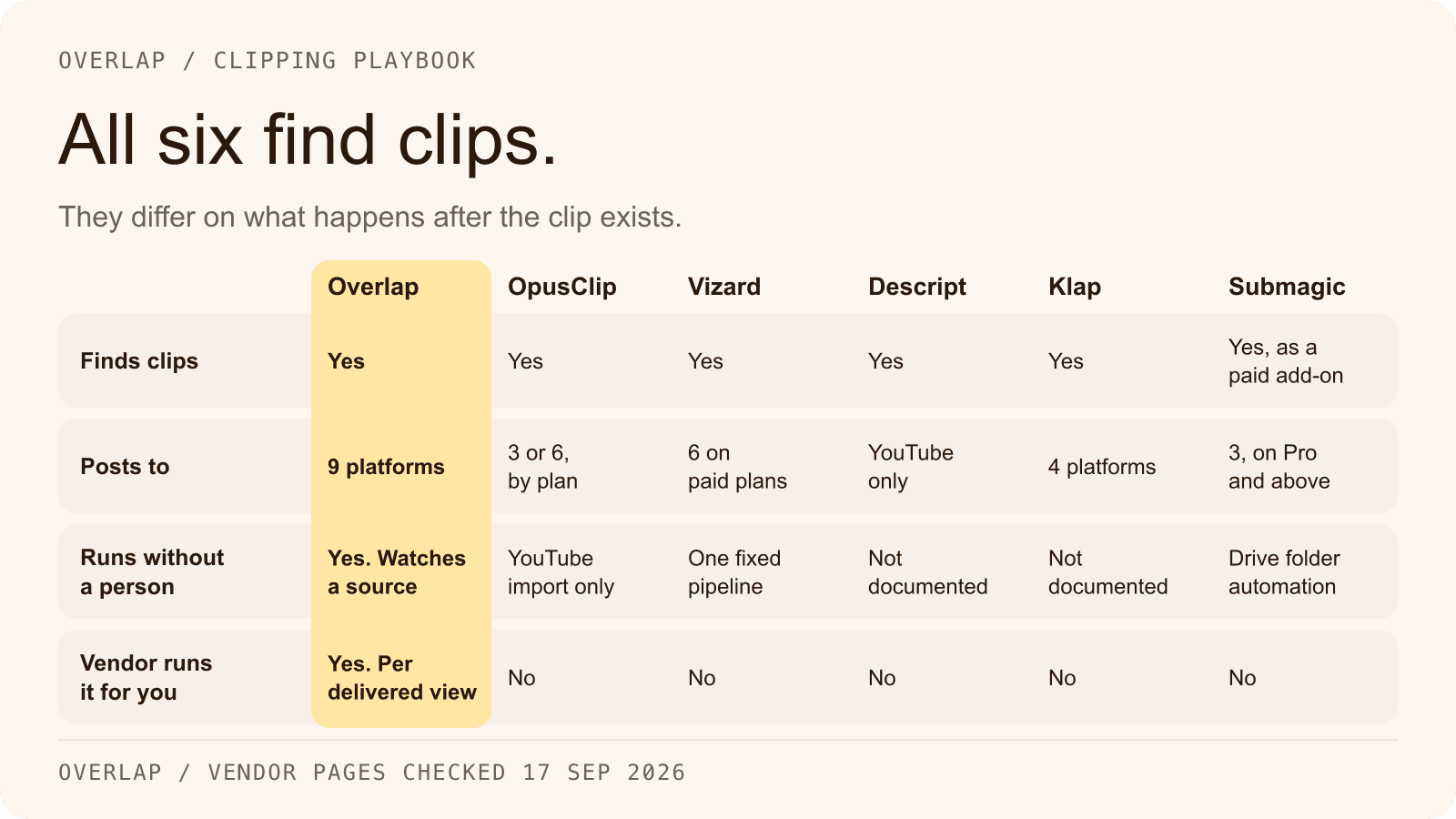
Most AI clipping tools were built for creators: solo podcasters, YouTubers, and social media teams managing a single channel. Newsrooms have fundamentally different requirements, and the tooling needs to match.
Overlap is a Y Combinator-backed AI platform built specifically for the end-to-end workflow described above: ingestion, AI-driven clip selection, editing, branding, scheduling, and analytics, all in one system. The distinction matters because piecing together five separate tools to cover these stages creates friction, inconsistency, and version control problems that kill the workflow before it scales.
What Sets Overlap Apart for News Teams
Agentic workflows, not manual steps. Overlap's AI doesn't just suggest clips; it executes the workflow. From upload to formatted, captioned, branded clips ready for review, the process runs automatically. News teams review and approve; they don't manage the pipeline step by step.
Multi-platform distribution in a single pass. Once a clip is approved, Overlap publishes to TikTok, Instagram Reels, YouTube Shorts, and other platforms simultaneously, with platform-specific formatting handled automatically. No re-exporting, no separate scheduling tools, no manual resizing.
Brand consistency at scale. Newsrooms have brand standards: lower thirds, logo placement, color schemes, caption styles. Overlap's brand kit system applies these automatically across every clip, so a clip published at 11 PM looks identical to one published at 9 AM, regardless of which editor approved it.
Analytics that close the loop. Overlap's analytics layer tracks clip performance across platforms and feeds insights back into the workflow. Over time, this data tells you which story categories, reporters, clip lengths, and hook styles drive the most engagement with your specific audience.
The Operational Difference
Consider the contrast between a newsroom running manual clipping versus one running an Overlap-powered workflow:
| Manual Workflow | Overlap AI Workflow | |
|---|---|---|
| Time from broadcast to published clip | 4-12 hours | 30-60 minutes |
| Clips generated per broadcast | 1-3 | 8-15 |
| Platforms published to | 1-2 | 5+ simultaneously |
| Editor time per broadcast | 3-5 hours | 15-20 minutes |
| Consistency of branding | Variable | Automatic |
| Performance feedback | Manual reporting | Automated analytics |
The math is straightforward. A newsroom publishing one clip per broadcast to one platform is not competing with one publishing 12 clips across five platforms within the hour. The audience is identical. The output is not.
Short-Form Video Distribution: The Metrics That Actually Matter
Most newsrooms that do publish short-form video track the wrong metrics. Follower count and total views are vanity numbers. The metrics that tell you whether your clipping workflow is working are fundamentally different.
Retention Rate Over Raw Views
Retention rate (the percentage of a clip that viewers watch before dropping off) is the single most important signal for short-form news content. Platforms algorithmically amplify content with high retention. A clip with 10,000 views and 75% retention will be distributed far more aggressively than one with 100,000 views and 15% retention.
Target benchmark: aim for 50%+ average view duration on clips under 30 seconds. For clips between 30 and 90 seconds, 40%+ is a strong baseline.
Saves and Shares Over Likes
Likes are passive engagement. Saves and shares are intent signals.
- Saves indicate the viewer found the clip valuable enough to return to. For news content, this often signals informational value.
- Shares indicate the viewer found the clip worth distributing to their own network. This is organic reach that no ad budget can replicate.
A news clip that gets 500 saves and 200 shares will outperform an entertainment clip with 5,000 likes in terms of actual audience growth.
Watch Time as a Distribution Signal
Total watch time (views multiplied by average duration) is what drives algorithmic reach on TikTok and YouTube Shorts specifically. Publishing multiple clips from the same broadcast compounds total watch time for your account, which accelerates distribution for future clips. This is the compounding effect of a high-volume clipping workflow, and it's invisible to newsrooms publishing one clip per day.
Platform-Specific Engagement Rate
Engagement rates vary significantly by platform. Socialinsider 2026 data shows TikTok at 4.20% engagement by views, compared to Instagram Reels at 1.95%. A clip that underperforms on Reels may be a strong performer on TikTok. Cross-platform analytics, the kind Overlap provides natively, are the only way to see this clearly without manually pulling data from five separate dashboards.
Common Objections (And Why They Don't Hold Up)
Newsroom leaders considering an AI clipping workflow typically raise the same set of concerns. They're worth addressing directly.
"We don't have the staff to manage another platform." This is the objection that most clearly reflects the manual-workflow mindset. An AI clipping workflow doesn't require more staff; it requires less manual time from existing staff. The Overlap workflow reduces editor time per broadcast from hours to minutes. The question isn't whether you have staff to manage it. It's whether you can afford to keep spending editorial hours on tasks the AI handles in seconds.
"Our audience is older and not on TikTok." The age distribution of short-form news consumers is shifting faster than most newsrooms track. Pew Research data from September 2025 shows that 25% of adults aged 30 to 49 now regularly get news on TikTok, up from 2% in 2020. This isn't a teen platform anymore. And YouTube Shorts, which skews older than TikTok, is averaging 200 billion daily views. Your audience is there. They're just not finding your content because you're not publishing it.
"AI clipping will produce inaccurate or misleading clips." This is the most legitimate concern, and the right answer is to design the workflow around it rather than avoid the workflow entirely. AI surfaces candidates; editors approve. No clip publishes without a human review step. The AI doesn't replace editorial judgment; it removes the hours of manual labor that precede it. Newsrooms that configure a clear editorial review checkpoint in their workflow have the same accuracy control they've always had, just with a much faster pipeline feeding into it.
"We tried short-form video and it didn't work." The real question is: how many clips were published per week, to how many platforms, over how long a period? Most failed short-form experiments involve posting one to three clips per week to a single platform for four to six weeks. That's not a test of whether short-form works. It's a test of whether posting almost nothing produces results. It doesn't.
The Newsroom Clipping Playbook for 2026
Putting it all together, here's the operational framework newsrooms should be building toward this year.
Treat Every Long-Form Asset as a Clip Library
Every broadcast, field interview, press conference, and panel discussion your newsroom produces contains multiple clips. The mindset shift is from "we made a 22-minute segment" to "we made 12 potential clips and one 22-minute segment." The long-form content is the source material. The clips are the distribution layer.
Set a Minimum Publishing Cadence
Algorithmic platforms reward consistency. A newsroom publishing eight clips per day across three platforms will build algorithmic momentum that a newsroom publishing three clips per week will never achieve. Set a minimum cadence, even if it means publishing more clips from older content initially, and hold to it.
Recommended starting cadence:
- 5-8 clips per day across TikTok, Instagram Reels, and YouTube Shorts
- 2-3 clips per day on X for breaking news context
- 1-2 clips per week on LinkedIn for analysis and commentary
Assign Editorial Ownership
The AI workflow needs one owner inside the newsroom: someone responsible for reviewing the AI's shortlist daily, approving clips, monitoring performance, and feeding insights back into the workflow configuration. This doesn't require a new hire. It requires designating an existing editor or producer as the short-form workflow lead.
Build the Feedback Loop Into Your Editorial Meetings
Weekly performance reviews of clip data should inform story assignment and interview framing. If data shows that clips featuring specific reporters, question formats, or story categories consistently outperform others, that's intelligence your assignment desk should be using. The clip workflow isn't just a distribution tool; it's an audience research instrument.
Start With Overlap
The fastest path to a functional AI clipping workflow is a platform that handles the entire pipeline, not a stack of disconnected tools. Overlap covers ingestion, AI clip selection, editing, branding, multi-platform publishing, and analytics in a single system designed for teams producing high-volume content at speed.
For newsrooms that have been putting off the short-form video conversation, 2026 is the year the cost of inaction becomes visible in the audience numbers. The infrastructure to change that is available now.
Key Takeaways
- 1 in 5 U.S. adults now get news on TikTok regularly; among under-30s, it's 43%
- Instagram and TikTok together drive 82% of total social engagement for news publishers
- Manual clipping is an operational bottleneck, not a creative one; AI removes the bottleneck
- An AI clipping workflow generates 8-15 clips per broadcast in the time it takes to manually cut one
- The right metrics are retention rate, saves, shares, and watch time; not views or follower count
- Newsrooms need a single platform covering ingestion through analytics, not a stack of disconnected tools
- Overlap is built for exactly this workflow: agentic clip selection, multi-platform distribution, brand consistency, and performance analytics in one system