On this page
- What the Clipping Economy Actually Is
- Why Clipping Is Exploding Right Now
- The Geese Controversy and the Authenticity Problem
- How Clipping Is Moving Beyond Music
- The Problem With How Most Brands Will Approach Clipping
- Why Overlap Exists: Clipping as an Owned and Earned Media Channel
- What Comes Next for the Clipping Economy
When OpenAI reportedly paid $200 million for TBPN, a tech podcast averaging just 7,000 live viewers per episode, the media world scratched its head. The acquisition made no sense on paper, until you looked at the clips. TBPN's average clip generates 257,000 views, 37 times the audience of the show itself. OpenAI wasn't buying a podcast. It was buying a clip machine.
That deal is the clearest signal yet that we are living through a fundamental shift in how content reaches audiences. The show is no longer the product. The clip is.
The clip economy is here: brands, labels, agencies, and media companies are now paying armies of independent editors to slice long-form content into short, shareable moments and seed them across TikTok, Instagram Reels, YouTube Shorts, and X, often without any disclosure that a campaign is running at all.
This isn't a niche creator tactic anymore. Variety reported in March 2026 that clipping has become so integral to music promotion that major and independent record labels now offer it as a standard marketing service. Business Insider noted the same month that clipping is blurring the line between organic popularity and manufactured virality in ways even savvy internet users can't reliably detect.
The question for any brand or media team right now isn't whether clipping works. It's whether they understand it well enough to build it into their strategy before the window closes.
What the Clipping Economy Actually Is
Clipping, in its modern marketing sense, is the practice of hiring independent contractors to pull short, high-impact moments from long-form content and distribute them across social platforms at scale. A clipper might take the most compelling 45 seconds from a three-hour livestream, a standout moment from a podcast interview, or a viral-ready snippet from a live performance, and post it across dozens of accounts to maximize algorithmic reach.
The practice originated in the livestreaming world. Streamers like Druski, Kai Cenat, and Adin Ross were among the first major beneficiaries, building massive cross-platform audiences through clips that fans and paid contractors spread far beyond the original broadcast. The music industry noticed and adapted the model quickly.
How a Clipping Campaign Works
The mechanics are straightforward, but the scale is what makes it powerful:
- A brand, label, or agency sets a campaign brief with specific guidelines (what content to clip, what captions to use, what to avoid, which platforms to target)
- A clipping platform or agency recruits clippers, independent editors who post clips across accounts they control, sometimes dozens of accounts per person
- Clippers are paid per 1,000 impressions, typically $1 to $5 per 1,000 views, incentivizing them to post as much as possible and optimize for engagement
- The algorithm does the rest, picking up high-retention clips and distributing them to new audiences who have no idea the content is part of a coordinated campaign
Campaign budgets are relatively modest. According to Variety, clipping campaigns typically run between $1,000 and $5,000, a fraction of what a single influencer post costs. John Summit's campaign for his single "Lights Go Out" ran on an initial budget of $1,050 over eight days and generated 32.4 million views across 29 approved clips from 13 creators. The top clip alone hit 5.3 million views.
The Infrastructure Behind It
Whop, a platform that launched in 2021 as a software marketplace, has become the central hub for clipping campaigns. It provides an automated payout system, bot detection to prevent inflated impression counts, and a marketplace where brands can recruit clippers at scale. The platform's traction attracted early investment from Peter Thiel and Insight Partners in a $17 million Series A, and last month it raised an additional $200 million from stablecoin company Tether, bringing its valuation to $1.6 billion.
That valuation tells you everything about where the money is flowing in digital marketing right now.
Why Clipping Is Exploding Right Now
Three forces converged to make clipping the dominant distribution tactic of 2026, and none of them are going away.
Algorithms Reward Clips Over Source Content
Short-form video platforms are engineered to surface content that holds attention, not content that comes from big accounts. A clip from a 7,000-viewer podcast can outperform the original broadcast by a factor of 37, as TBPN's numbers demonstrate. The algorithm doesn't care about follower counts. It cares about retention, and a well-chosen 45-second clip consistently outperforms a 90-minute episode in that metric.
This creates a structural incentive: the clip is the most efficient unit of distribution, not the original content. Every long-form asset a brand produces is now also a potential library of high-performing short-form posts, if it's processed correctly.
The Cost Advantage Over Traditional Paid Media
The economics of clipping are genuinely difficult to argue with. Compare the cost per qualified view across common marketing channels:
| Channel | Cost Per View |
|---|---|
| Traditional content agencies | $0.01 to $0.10 |
| Paid influencer networks | $0.05 to $0.30 |
| Managed clipping campaigns | ~$0.003 |
That's a 3x to 100x cost advantage depending on the comparison point. For brands operating under tighter budgets, clipping offers reach at a scale that paid social simply can't match at equivalent spend levels.
Clipping Removes the Artist (or Brand) From the Equation
One of the most underappreciated advantages of clipping is that it doesn't require the creator to do anything. As Variety noted, "content captures" are regularly baked into musicians' schedules, but clipping removes that need entirely by leaning on footage captured elsewhere: red carpet appearances, live performances, podcast appearances, even decade-old archival footage.
For brands, the parallel is direct. Every webinar, every executive interview, every product demo, every conference panel is a source asset. Clipping turns passive content archives into active distribution engines without requiring anyone to produce new material.
"I don't know anybody not utilizing clipping who's actually competitive in the marketplace." — Sam Alavi, CEO of Right Click Culture and manager of rapper Bbno$
That quote is from the music industry, but it's the kind of statement that tends to migrate across verticals quickly.
The Geese Controversy and the Authenticity Problem
In April 2026, a WIRED investigation revealed that a marketing agency had promoted the buzzy rock band Geese by flooding TikTok with clips posted from accounts created by the agency itself, what are sometimes called "sock puppet" accounts. The agency's founders described the tactic in detail on a Billboard podcast, apparently without concern that it would be controversial.
It was. The story ignited a debate about what's real and what's manufactured online, and whether clipping crosses an ethical line.
Business Insider's Katie Notopoulos framed the core tension well: we've spent a decade training ourselves to spot influencer marketing, sponsored posts, and branded content. But clipping is different. It doesn't look like advertising. It looks like a fan account. It looks like organic enthusiasm. And that invisibility is precisely what makes it effective.
The FTC Gap
There's a regulatory dimension here that most coverage has glossed over. Influencer marketing is subject to FTC disclosure guidelines that require creators to clearly label paid partnerships. Clipping, as currently practiced, operates in a regulatory gray area. The FTC declined to comment to Variety on whether clipping falls under its disclosure requirements.
That gray area won't last forever. But for now, it gives clipping a structural advantage over influencer marketing: campaigns run without the "paid partnership" label that signals advertising to a trained audience.
Does Authenticity Still Matter?
The consensus among industry insiders is nuanced. Geese is genuinely a popular band. Bbno$ makes music people actually like. TBPN produces content that tech audiences want to watch. You can't manufacture virality for something people don't find compelling. Clipping amplifies what's already there. It doesn't create appeal from nothing.
The real risk isn't inauthenticity. It's misalignment. A clipping campaign built around content that doesn't genuinely resonate will burn budget and produce nothing. The music industry figured this out fast: clipping works when the underlying content is strong. It fails when it's used as a substitute for quality.
That distinction matters enormously for how brands should think about building their own clipping programs.
How Clipping Is Moving Beyond Music
The music industry was the first to systematize clipping, but the underlying logic applies to any content-rich vertical. The pattern is already spreading.
Media and Podcasting
The TBPN acquisition is the most dramatic example, but it's part of a broader shift in how podcast networks and media companies think about distribution. The live audience is a vanity metric. The clip audience is the real number. Stand-up comedy specials, right-wing podcasts, personal finance YouTube channels, and tech news livestreams are all running coordinated clipping campaigns, often through the same Discord channels and Whop infrastructure that music labels use.
One analysis cited by Business Insider showed that while TBPN's live shows average 7,000 viewers, its clips average 257,000 views. That's not a content strategy. That's a business model.
Brands and B2B Content
The migration to brand marketing is still early, but the economics are compelling enough that it's inevitable. Consider what most mid-size companies already produce:
- Executive interviews and thought leadership videos
- Conference keynotes and panel appearances
- Product demos and explainer content
- Webinars and customer success stories
- Podcast appearances by founders or team members
Every one of those assets is a potential clip library. A 45-minute webinar might contain five moments that, properly extracted and distributed, could each reach tens of thousands of relevant viewers at a cost that makes paid social look wasteful by comparison.
The Comparison to Influencer Marketing
Clipping is often compared to influencer marketing, and the comparison is instructive. With influencer marketing, a brand pays one creator tens of thousands of dollars for a single post that reaches that creator's audience. With clipping, the same budget floods dozens of accounts with content that reaches the algorithm's audience, not a specific creator's followers.
The key difference: clipping doesn't depend on someone else's audience. It depends on the content itself finding its own audience through the feed. That's a fundamentally different, and in many ways more scalable, distribution model.
"It gives you more flexibility and agility to move around with smaller pockets of budget." — Thiago Machado, founder and CEO of Ranked Music
The Problem With How Most Brands Will Approach Clipping
Here's the failure mode that's coming: brands will discover clipping, hand it to their paid media team, run a few campaigns, see decent CPV numbers, and then treat it like another line item in the ad budget. When the campaign ends, the clips stop. The audience disappears. Nothing compounds.
That's the wrong model entirely, and it's the mistake that separates brands that extract short-term impressions from brands that build lasting distribution infrastructure.
Clipping Treated as Paid Ads
When clipping is treated as a paid campaign, the logic is transactional: spend budget, generate views, measure impressions, repeat next quarter. The clips live on third-party accounts. The brand controls nothing. The moment spend stops, reach stops. There's no asset being built, no audience being owned, no compounding return on the content investment.
This approach also creates dependency on external clipping agencies and platforms, which means the brand has no institutional knowledge of what works, no creative consistency, and no long-term relationship with the audiences those clips reach.
The Paid vs. Owned/Earned Distinction
| Approach | Control | Compounding | Sustainability |
|---|---|---|---|
| Clipping as paid ads | Low (third-party accounts) | None (stops with spend) | Expensive to maintain |
| Clipping as owned/earned channel | High (brand-controlled assets) | High (clips build catalog) | Scales with content output |
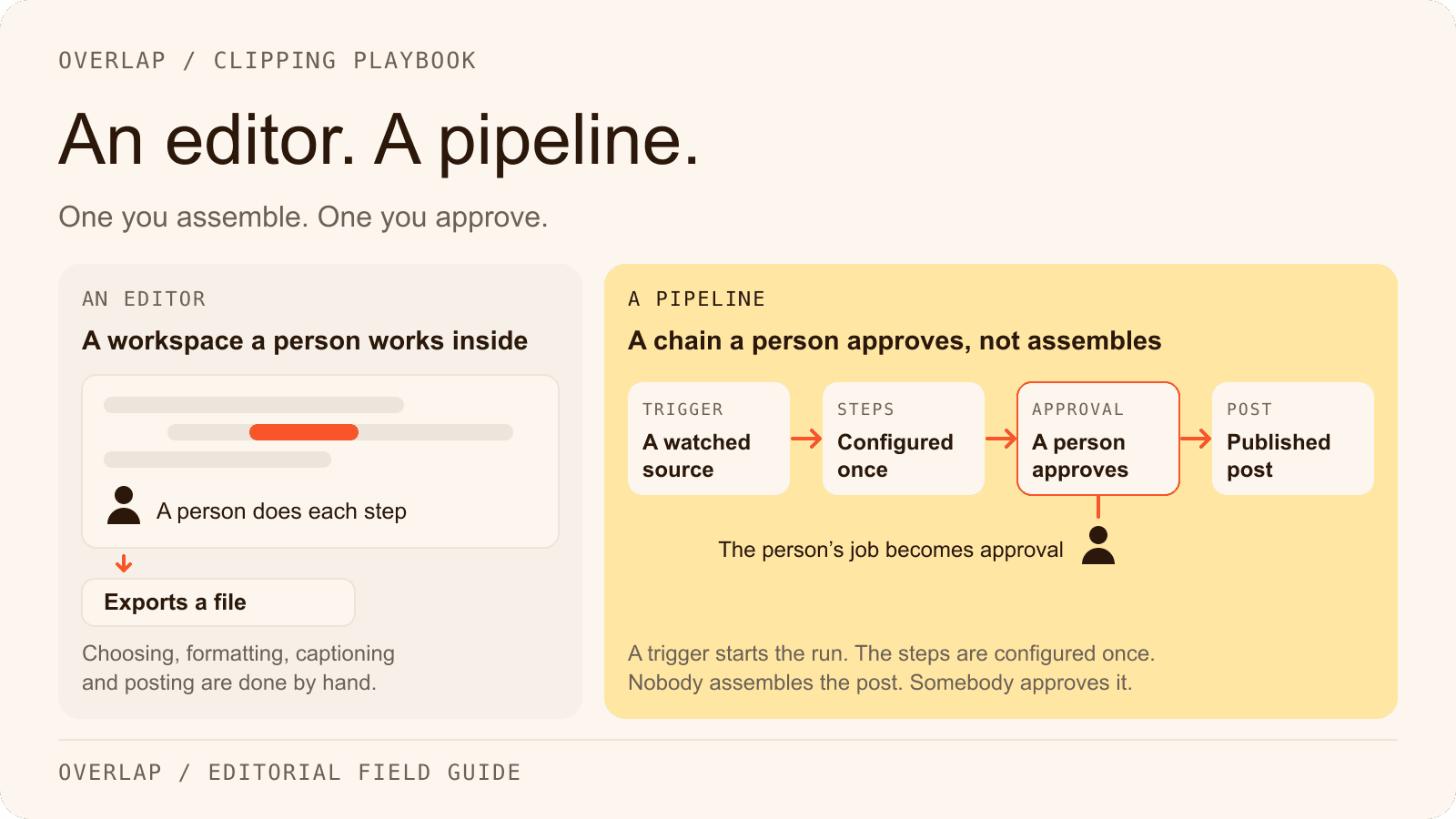
The brands that will win in the clipping economy are the ones that treat it as a media channel, not a media buy. That means building their own clip library, publishing consistently from owned accounts, and optimizing the pipeline over time so that every piece of long-form content automatically generates a distribution-ready clip catalog.
The goal isn't to run a clipping campaign. It's to become a clipping operation.
That distinction changes everything: the team structure, the tooling, the metrics, and the relationship between the content being produced and the audiences being built.
Why Overlap Exists: Clipping as an Owned and Earned Media Channel
This is the insight that drives Overlap's approach to clipping: the future of this channel doesn't belong to agencies running sock puppet campaigns. It belongs to brands that build the infrastructure to clip, distribute, and optimize their own content at scale, continuously, not campaign by campaign.
Overlap is an AI-powered platform built specifically for this. It automates the end-to-end workflow of turning long-form video into short-form clips, handling everything from intelligent moment selection and editing to social planning and cross-platform publishing across TikTok, Reels, and Shorts.
What Building Clipping as an Owned Channel Actually Looks Like
The difference between a clipping campaign and a clipping channel comes down to three things:
1. Consistent pipeline, not one-off production An owned clipping channel means every piece of long-form content, every podcast episode, every webinar, every event recording, automatically feeds a clip production workflow. The output isn't a dozen clips for a launch campaign. It's a steady stream of clips that build audience over weeks and months.
2. Brand-controlled distribution Clips published from owned accounts build followers, analytics, and institutional knowledge. Every clip that performs well tells you something about what your audience responds to. That data compounds. Third-party clipping campaigns generate impressions that disappear when the campaign ends. Owned channels generate audiences that stay.
3. Earned media as the north star When clipping is done right, it earns organic reshares, comments, and engagement that extend reach far beyond the initial post. That's the earned media layer: content that works so well it travels on its own. Paid campaigns can seed reach, but they can't manufacture genuine resonance. An owned clipping operation, built on content that actually matters to an audience, can.
The Compounding Advantage
The brands that start building clipping infrastructure now will have a significant structural advantage in 12 to 18 months. They'll have a clip library that's already optimized for their audience, a publishing cadence that's trained the algorithm to favor their content, and analytics that tell them exactly which moments from their long-form content drive the most engagement.
Brands that wait and then try to buy their way in with agency campaigns will be paying for reach that their competitors are generating organically.
The clip economy is still early enough that building an owned channel is a competitive differentiator. That window won't stay open indefinitely.
Overlap is built for teams that want to move now, before clipping becomes as crowded and expensive as every other paid channel eventually does.
What Comes Next for the Clipping Economy
The trajectory is clear. Clipping will follow the same arc as every major digital marketing channel before it: early adoption by scrappy operators, rapid mainstream uptake, eventual saturation, and then a shakeout that rewards the brands with the strongest infrastructure and content quality.
A few developments will accelerate this:
- AI-powered clip selection is already emerging. Tools that automatically identify the highest-engagement moments from long-form content based on semantic analysis, audience behavior patterns, and platform-specific optimization will reduce the skill barrier and increase clip output volume dramatically.
- Regulatory clarity will come eventually. When the FTC establishes disclosure standards for clipping, the advantage will shift from campaigns that look organic to channels that are genuinely trusted. Brands with owned audiences will be better positioned than those relying on third-party clippers.
- Platform algorithm changes will continue to favor consistent publishers over one-off viral moments. TikTok and YouTube Shorts already reward accounts that publish regularly. The brands building owned clipping channels now are training those algorithms in their favor.
Whop CEO Steven Schwartz put the larger vision plainly in his Variety interview: "I view clipping as act one of what this new internet economy looks like, where you have all these people doing micro jobs for cash, and being part of a bigger movement and business."
Act one is already underway. The brands that treat clipping as a channel rather than a campaign will be the ones still standing when act two begins.
The clip isn't a tactic. It's the new unit of media. Build accordingly.