On this page
- What YouTube announced for February 2027
- Track the terms deadline and activity requirement separately
- The operational issue: your best month eventually leaves the window
- Which Shorts views count toward monetization?
- More clips will not fix a reused-content problem
- Rewrite the agency offer around work you can stand behind
- Build a repeatable Shorts workflow in Overlap
- Frequently Asked Questions
YouTube's announced 2027 monetization changes make recent qualified Shorts views a planning concern for clipping agencies. A channel's lifetime views will not tell you whether its current production plan supports the next earning window. Agencies should track the relevant rolling totals and keep platform payouts separate from the value of the service they sell.
Checked October 15, 2026. These changes were announced August 10 and take effect February 1, 2027. They are not the rules already in force this October. YouTube's announcement
What YouTube announced for February 2027
The announcement separates ongoing Shorts earnings from entry into the YouTube Partner Program's ad and Premium revenue sharing:
| Situation | Announced requirement |
|---|---|
| Ongoing Shorts ad and subscription revenue eligibility | 10 million qualified Shorts views over the previous 90 days |
| New applicants seeking YPP ad and Premium revenue sharing | 1,000 subscribers plus 8,000 qualified watch hours over 365 days, or 1,000 subscribers plus 20 million qualified Shorts views over 90 days |
| Existing YPP channel below the Shorts earning threshold | Remains in YPP and can continue long-form earnings; Shorts sharing resumes after the threshold is reached again |
The revised entry thresholds do not apply to creators already in YPP. Fan-funding and shopping entry thresholds remain unchanged. These figures describe the announced view and watch-hour changes, not a complete account-eligibility checklist. Check the terms offered to your channel in Studio. Current YPP help, official YPP update
Track the terms deadline and activity requirement separately
YouTube tells creators to review the updated modules in Studio by January 31, 2027. Missing acceptance stops earnings from the associated features from February 1 until acceptance; it does not itself remove YPP membership. YouTube's terms guidance
From February 1, its activity test is any of: 1,000 qualified watch hours in 365 days; one million qualified Shorts views in 90 days; or two long-form uploads or five Shorts in 90 days. The documented 90-day restoration window uses the watch-hour or Shorts-view routes, not the upload route. Channel activity and restoration
For an agency, keep three decisions on separate lines: has the authorized channel owner reviewed the modules, is the channel active, and does it qualify for the particular earning feature? Passing one does not answer the other two.
For example, a hypothetical show publishing two full interviews in a 90-day period could satisfy the upload-based activity route while missing the ten-million Shorts threshold. Publishing another interview would not settle that Shorts earnings question. Likewise, an agency can deliver every agreed clip while the owner still has an outstanding terms action.
Create a small owner-review record for each channel: channel URL, responsible owner, modules shown in Studio, review status, activity route, qualified Shorts total and observation date. Keep uncertain values blank and assign an owner to resolve them. The agency should surface the decision; the authorized party should review and accept the terms.
The operational issue: your best month eventually leaves the window
Imagine a channel with 12 million qualified Shorts views in its current 90-day window. Over the next 30 days, 5 million of those views age out and 2 million new ones arrive. The new rolling total is 9 million, even though lifetime views have increased.
That is illustrative arithmetic, not a customer result. It explains why a screenshot of an all-time milestone can conceal a weakening recent run rate.

Build the agency report around what is entering and leaving the window. A weekly update can contain the current qualified total, the views due to age out over the next reporting period, recent additions and the largest contributing videos. That last item exposes concentration: a channel leaning on one breakout clip has a different outlook from one with several repeatable formats.
Do not turn the target into a promise that posting more will solve the problem. Dividing ten million by ninety gives a planning average of about 111,111 qualified views per day. It does not create a daily requirement, and it certainly does not establish how many clips will produce that average.
Which Shorts views count toward monetization?
YouTube's August 12 explanation says qualified Shorts views come from public Shorts and must be engaged views. It defines engagement here as watching beyond the initial seconds; loops do not count. Private, unlisted, deleted and ad-driven Shorts views are excluded. YouTube's qualified-views explanation
Use the eligible view totals shown in Studio and the relevant Analytics measures. Do not reconstruct eligibility by summing whatever numbers happen to be easiest to export from a social dashboard.
The same distinction applies to a podcast's long-form route. YouTube says public long-form videos, including podcasts, and archived livestreams can contribute qualified watch hours. Shorts watch hours do not contribute to that route. Qualified watch hours
For a show with both full episodes and clips, keep two separate scoreboards. One tracks long-form viewing and returning listeners. The other tracks Shorts discovery and the relevant qualified-view window. A Short that sends the right person to a full episode can be useful even when it is not the largest Short in the batch.
More clips will not fix a reused-content problem
The source of the footage and the editorial contribution still matter. YouTube's monetization policies distinguish original work and substantive transformation from reused or mass-produced material. Having permission is not, by itself, enough to satisfy its reused-content policy. YouTube channel monetization policies
For a client-owned podcast, document who produced the episode and what the channel is publishing. For a commentary channel using outside footage, the added reporting or analysis should be evident to the viewer. Neither a subtitle template nor a more aggressive posting schedule supplies a missing editorial contribution.
A practical review asks whether a viewer can identify the speaker, understand the claim and hear the qualification that makes it accurate. A dramatic opening followed by a cut before the caveat may win a view while creating a problem for the client.
Rewrite the agency offer around work you can stand behind
An agency can specify the source catalog, selection criteria, review process, publishing responsibilities and reporting cadence. It cannot control YouTube's payout calculations or guarantee discovery.
Consider three service designs:
- Production: Deliver approved edits, with a defined revision process and source records.
- Channel operation: Add scheduling, account-level reporting and a regular editorial review of what to repeat.
- Campaign distribution: Agree on a funded campaign's own payment rules, with platform revenue accounted for separately.
Spell out who owns the accounts and who receives any platform payments. If the client changes agencies, it should be clear what happens to the publishing history, audience and source archive.
YouTube also announced further earning initiatives whose details were still forthcoming in the cited update. Leave speculative bonuses out of the base budget. YouTube's earning-opportunity announcement
Build a repeatable Shorts workflow in Overlap
Overlap's New YouTube Video trigger can start a workflow from a channel or playlist. Find Clips supplies candidate moments using the brief; vertical framing and subtitles prepare them for review. The publishing node supports scheduling and post approval.
Configure the editorial brief around a particular viewer and a complete idea. For a business podcast, that might mean a specific decision, the alternative considered and what happened afterward. It is more actionable than asking the agent to find anything “viral.”
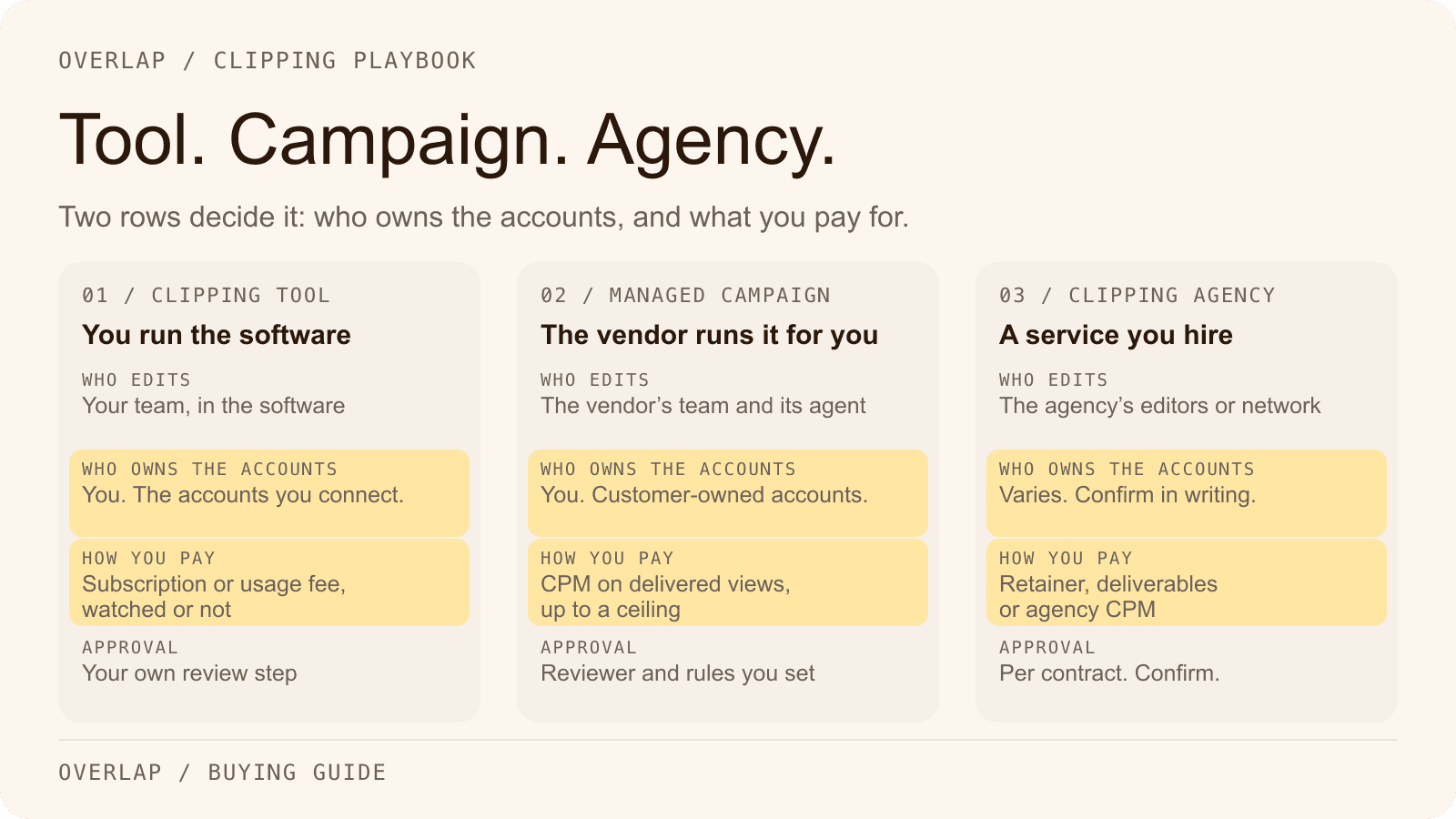
Keep monetization reconciliation in YouTube Studio. Overlap's production workflow and the platform's qualification calculations serve different purposes. Our AI clipping walkthrough shows the production steps, and the clipping campaign overview explains the service model for customer-owned accounts.
Before February, review a few representative channels with the same questions: what part of the revenue is contracted, which recent videos carry the view total, and what useful work remains valuable if platform rewards fall? Those answers make a stronger operating plan than a higher upload quota.
Frequently Asked Questions
Is the ten-million figure a daily posting target?
No. It describes a rolling view window. A daily average can help with planning, but it cannot predict how many uploads will succeed or replace the platform's eligibility calculation.
Should a clipping agency stop publishing full podcast episodes?
There is no reason to make that decision from Shorts metrics alone. Full episodes and clips serve different viewing needs. Compare each format's costs, audience behavior and role in the show's business before changing the mix.
Does using an AI clipping tool guarantee YouTube monetization?
No. An editing tool cannot grant channel admission, determine which views qualify or override content policies. The channel remains responsible for what it publishes.