On this page
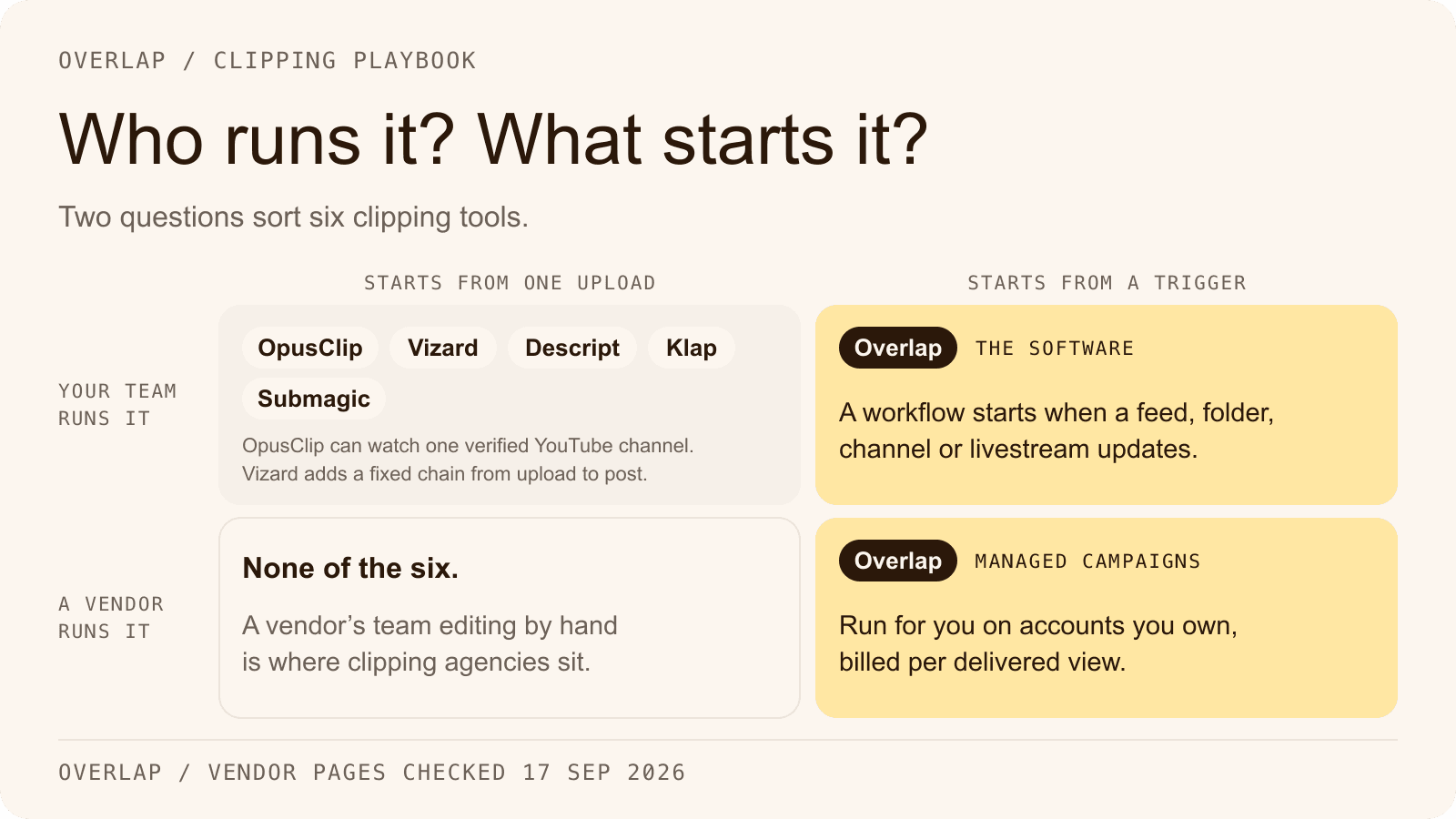
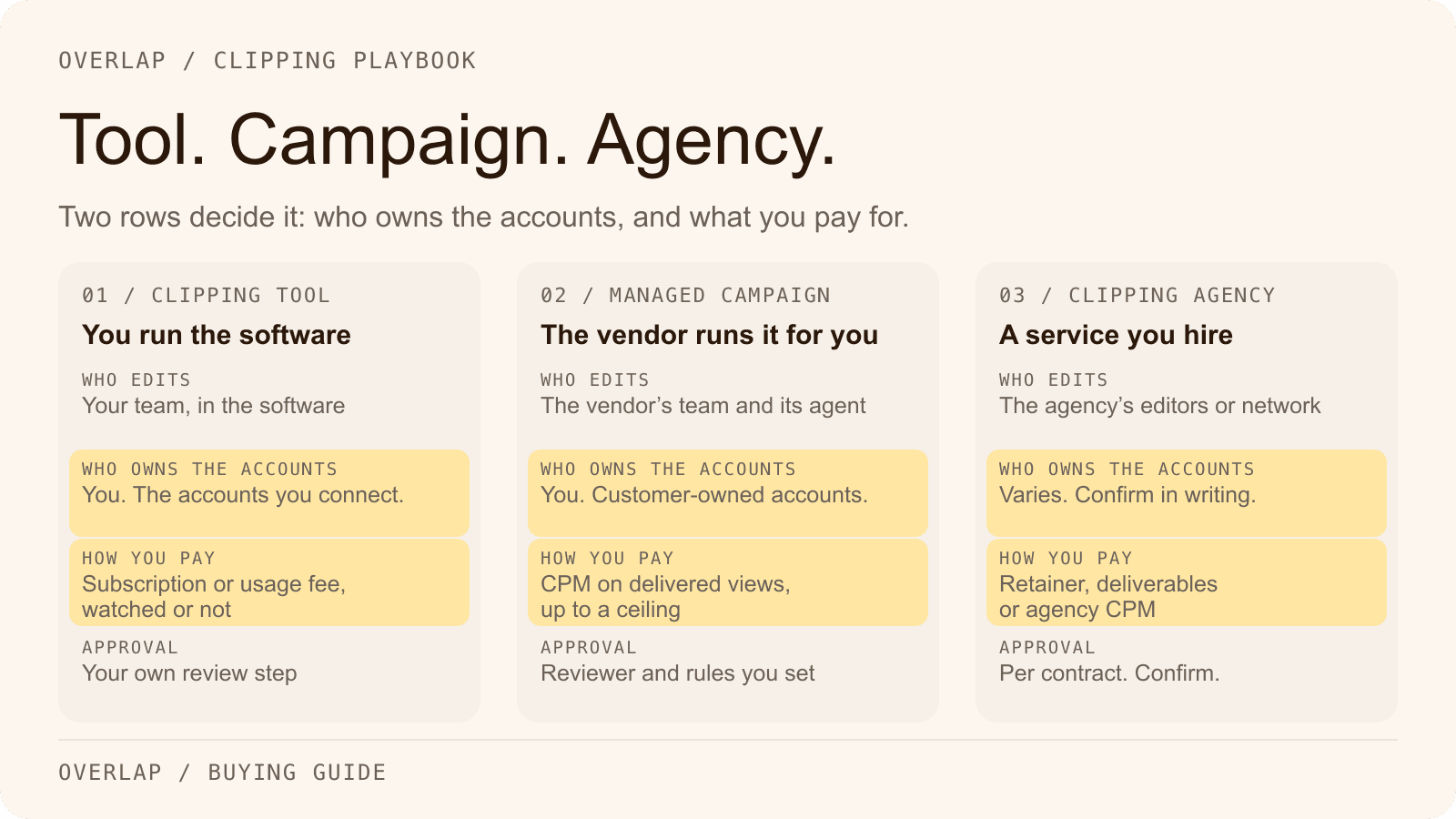
A clipping tool is software your own team runs: it finds the moments, cuts and captions them, and posts to accounts you connect, and you pay a subscription or a usage fee whether or not anyone watches. A managed clipping campaign is the same kind of software operated for you by the vendor's team, on accounts you own, and billed on the views the clips deliver. A clipping agency is a service business that supplies editors, producers or a creator network under its own contract, and the accounts it publishes to depend on the agreement. Two questions decide which model fits you: who owns the accounts the clips build, and what you are actually paying for.
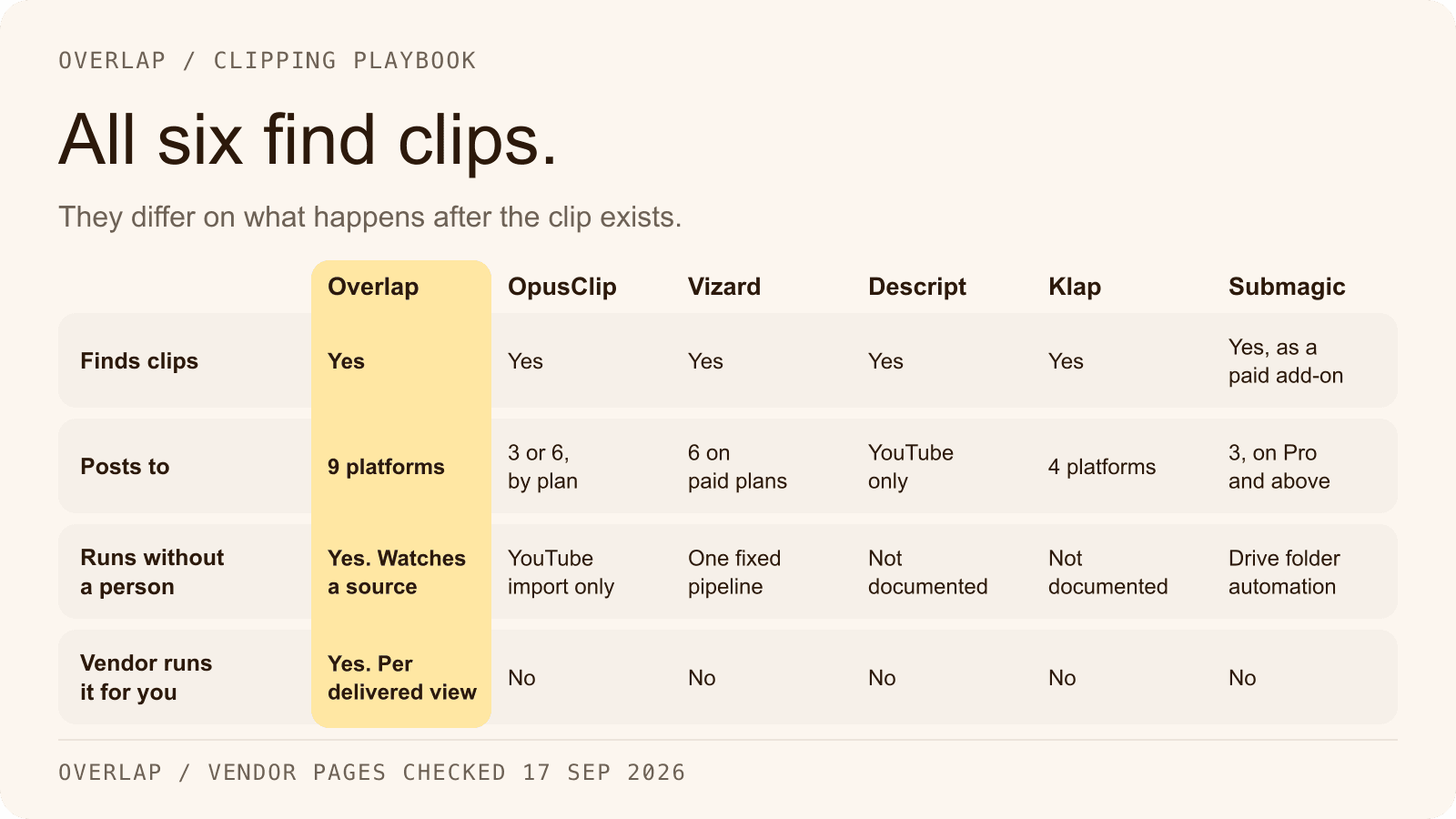
Every provider in this market can produce a captioned vertical clip. What separates them is what happens around the clip: who briefs the edit, who presses publish, whose analytics the results land in, and what is left when the money stops. This guide takes each model in turn, sets the three side by side, and lists the questions to ask any provider.
Disclosure: This guide is published by Overlap, which sells two of the three models discussed. Overlap is an AI video clipping platform that teams run themselves, and Overlap's team also runs managed clipping campaigns on that platform. It is not a clipping agency. The advice below is planning guidance and a description of published terms, not a controlled comparison of provider results.
The two questions that decide it
Most buying guides compare features. Those matter less than they look: a managed campaign runs on a tool, and an agency's editors use one too. The differences that still matter a year later are structural.
The first is account ownership. A clip that earns a million views on an account you do not control is a receipt. The same clip on your own handle is a follower base, a post library and a year of first-party analytics. The second is the unit of payment. A subscription pays for capacity, a retainer pays for hours, a per-deliverable fee pays for output, and a CPM pays for the reach that actually landed. Each one puts the risk of a clip nobody watches on a different party.

What a clipping tool gives you
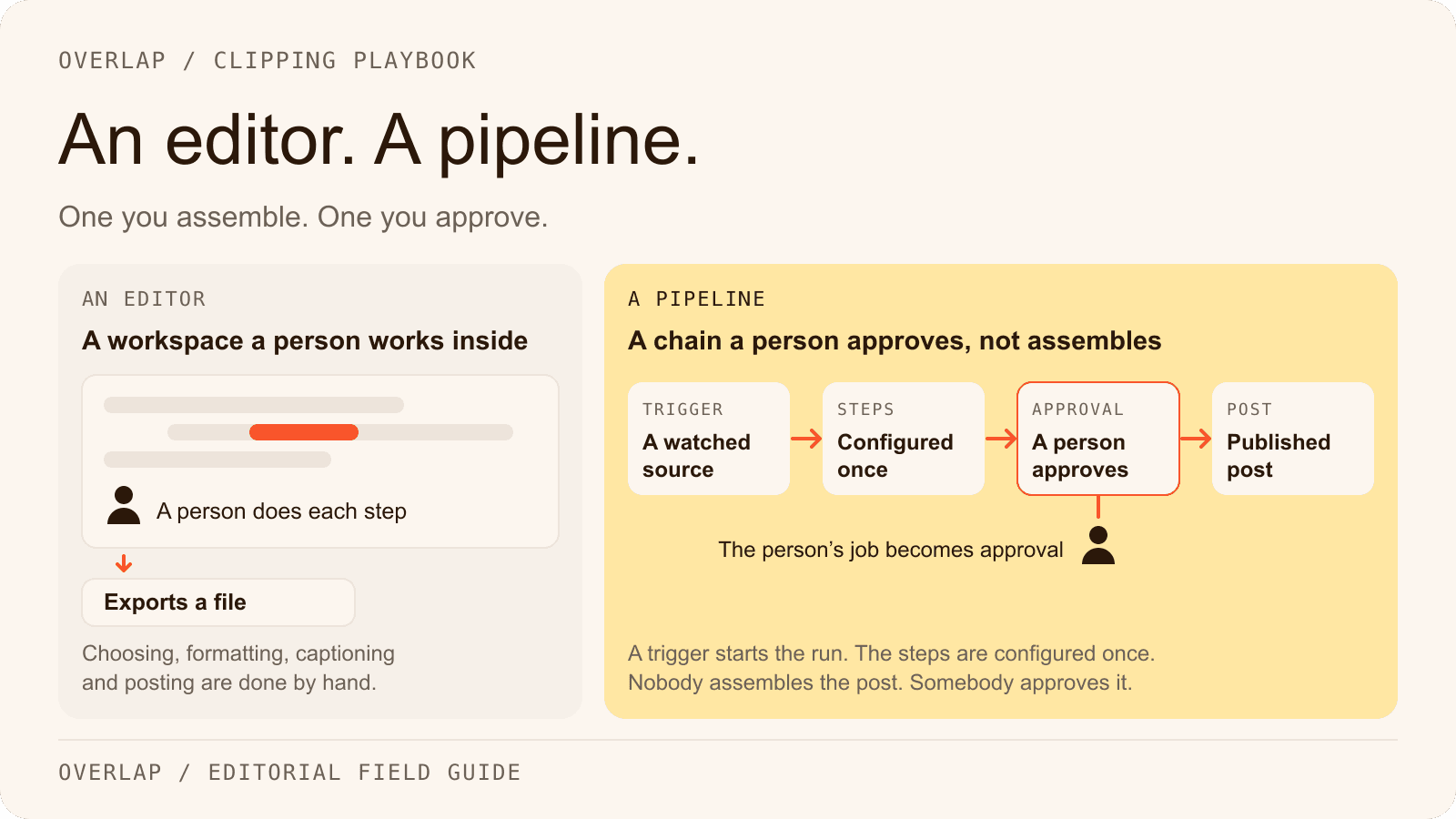
What you get. Software that turns a long recording into short clips. In Overlap the unit of work is a workflow: a trigger that says when to start, editing logic that shapes the clip, and an export step that defines what gets produced. Source: Overlap workflow documentation. A workflow can read from a manual upload, a YouTube channel or playlist, a Dropbox folder, an RSS, Atom or podcast feed, an audio livestream URL, an RTMP or HLS livestream, or Frame.io, and it can publish to TikTok, Instagram, YouTube including Shorts, X, LinkedIn, Facebook, Threads, Snapchat and Bluesky. See the AI video clipper for the editing steps and integrations for every source and destination.
Who does the work. Your team. The software cuts and captions, but someone on your side chooses the source, writes the rules, reviews what comes out and owns the publishing calendar. Overlap's Post to Social step can require approval before a post goes out, in which case the post waits in the social calendar until a person approves it. Source: Overlap social calendar documentation. That review step is a control you switch on, not a reviewer the vendor supplies.
Who owns the accounts. You do. A tool publishes through accounts you connect, so the handles, followers and analytics were yours before the software arrived and stay yours after it leaves.
How you pay. A subscription or a usage fee, charged whether or not the clips are watched, and vendors meter it differently. As checked on September 17, 2026, OpusClip's pricing page lists a Starter plan at $15 USD a month with 150 credits and a Pro plan at $29 USD a month, and its help centre defines a credit as one minute of imported source video. Source: OpusClip pricing and OpusClip help centre on credits. Overlap's documentation describes its software billing in processing hours and active workflows and prints no plan prices; see the pricing page, and the Overlap vs OpusClip comparison, which sets the two side by side with dated sources. Source: Overlap billing documentation.
Where it breaks. A tool has no opinion about whether anyone is operating it. The subscription runs while the workflow sits idle, and a team that bought software to avoid hiring an editor can find it has created an operator role instead. It fits a team that already publishes and wants more output from the same people, not a team with nobody to press the button. Overlap's iHeartMedia case study reports 600M views and 100K clips with no editors hired, on the platform run by iHeart's own team; a case study is one customer's outcome, not a benchmark.
What a managed clipping campaign gives you
What you get. The same clipping software, operated by the vendor's team as a service. On Overlap's model a campaign covers clip selection, editing, formatting, approval workflows, publishing and reporting, and it runs on accounts the customer owns. The customer supplies the recordings, the brand rules and the accounts; the campaign supplies everything between a recording and a published, tracked post.
Who does the work. The vendor. An agent does the cutting, captioning and posting under rules the customer sets during campaign setup: the reviewer, the publishing boundaries, and which clips require approval before they publish. The customer approves the rules and, if they choose, the clips; nobody on their side operates the software.
Who owns the accounts. The customer. The handles, the followers and every post published to them stay with the customer, the posts are not taken down when billing stops, and the accounts are never repurposed for another advertiser. Where an account qualifies for a platform's creator payouts or revenue share, that revenue belongs to the account owner.
How you pay. Per delivered view. On Overlap's published terms you set a monthly ceiling and agree a CPM between $0.50 and $2.50. Spend follows the views actually delivered and stops at the ceiling; there are no production fees, no minimum deliverables and nothing charged for reach that did not land. Views are read from the platforms' own analytics on posts published to your accounts, every view is organic, and a clip that was never posted is never billed. The campaign page carries a worked example with hypothetical inputs, not customer results.
Where it breaks. Organic reach is not a deliverable anyone can promise. The ceiling limits spend; it does not guarantee views, followers or conversions. A campaign needs recurring source content with people talking in it, so a brand with three recordings a year gives an agent little to work with. And the model does not cover original shoots, heavily bespoke motion design or access to a specific creator's existing audience, which is exactly what a specialist agency sells. Launch timing depends on source content, account access, brand rules, approvals and agreed terms; a planning schedule is not a guaranteed turnaround.
What a clipping agency gives you
What you get. A service. The scope runs from an editing team that returns finished clips for you to post, through full management of accounts and publishing, to distribution through a network of creators or clipper pages the agency coordinates. Overlap's clipping agency roundup reviewed the public pages of ten providers, dated beside each entry, and most did not say who owns the publishing accounts, what the pricing basis is or how a clip gets approved. Those answers live in the sales call, which is what the questions below are for.
Who does the work. The agency's people: editors and producers on retainer, or a network of creators and clippers it briefs and pays. That is the model's strength. Human judgment on a difficult edit, an original shoot, custom motion design and a creator's existing audience are things a tool does not supply and a managed campaign does not include.
Who owns the accounts. It depends on the contract. Some agencies post to accounts you own, some build brand handles they operate, and network services distribute through accounts that belong to creators or to the network. The audience accumulates wherever the posts live, so a proposal has to say in writing which accounts publish, who holds the logins, and what happens to the posts and to access when the engagement ends.
How you pay. A retainer, a per-deliverable fee, a CPM on the agency's own definition of a view, or a mix. A retainer is billed whether or not the clips land, a deliverable fee pays for output rather than reach, and an agency CPM cannot be compared with anyone else's until its eligible-view definition and counting window are written down. A creator marketplace, where a brand sets a reward per thousand views and independent clippers post to their own accounts, is a fourth model with its own rules; the content rewards guide covers it.
Where it breaks. Coordination. Every clip passes through a brief, a revision round and a handoff, so cadence is set by the agency's calendar rather than your publishing schedule. Reporting is the agency's report unless you can open the platform dashboards yourself. And when a network engagement ends, the reach it delivered stays on the network's accounts. The earlier guide on clipping agents versus clipping agencies goes further into that operating-model trade.
Compare the three models side by side
The tool and agency rows describe the model in general; the managed campaign row is filled from Overlap's published terms, the one model this site can document. Where a cell says confirm, the provider's contract is the only source that counts.
| Model | Who does the editing | Who owns the accounts | How you pay | Approval control | Reporting | Best for |
|---|---|---|---|---|---|---|
| Clipping tool | Your team, using the software | You; the accounts you connect | Subscription or usage fee, watched or not | Your own review step, if you switch one on | The platforms' analytics, read by you | A team that already publishes and wants more output |
| Managed clipping campaign | The vendor's team and its agent, under rules you set | You; on Overlap's model the customer keeps the accounts, followers, posts and data | Agreed CPM on delivered views, $0.50 to $2.50 on Overlap's published band, up to a monthly ceiling; no production fees | You name the reviewer, the boundaries and which clips need approval | Included; platform analytics on your own accounts | Recurring long-form content and an audience you want to keep |
| Clipping agency | The agency's editors, producers or creator network | Varies by contract; confirm in writing | Retainer, per-deliverable fee or the agency's CPM; confirm the view definition | Varies; confirm who approves and how many revision rounds | The agency's report; ask for post URLs and dashboard access | Original production, bespoke creative direction or a specific creator's audience |
Questions to ask a provider
Ask every provider on the shortlist the same list, whatever model they sell.
- Which accounts will the clips publish to, and who owns each one? Ask for the handle, the login holder and the platform account type.
- What happens to the posts and to access when the engagement ends? Posts that come down with the invoice were rented, not built.
- Who selects, edits, approves and publishes a clip? Four verbs, four names. A team name is not an answer.
- What exactly am I paying for? Hours, deliverables, capacity or delivered views. Then ask what the bill looks like in a month when nothing lands.
- If you charge a CPM, which views count? Get the eligible-view definition, the counting window and the treatment of invalid traffic in writing before comparing rates.
- Can I see the platform dashboards myself? A report is a summary somebody chose. The post URLs and the native analytics are the record.
- What can be approved before it publishes, and by whom? Per clip, per batch or per rule set, and how long a clip waits for it.
Use the step-by-step clipping campaign guide to turn the answers into a brief, whichever model you land on.
Where Overlap fits
Overlap is an AI video clipping platform. Teams run it themselves, or Overlap's team runs managed clipping campaigns for them on accounts the customer owns, priced per delivered view. That is two of the three models in this guide sold as one product, which is why the disclosure at the top is prominent: the platform is the tool, and the campaign is that platform operated by Overlap's team. It is not an agency. Overlap does not supply editors on retainer, does not run original shoots and does not distribute through a creator network.
What the documentation establishes is the tool: the workflow model of trigger, editing and export, the sources and nine destinations listed above, an approval step in the social calendar, brand kits and posting personas, and a developer surface of a REST API and an MCP server, described on the automation page. The docs print no software plan prices, describe no Zapier app, webhooks or command-line tool, and say nothing about managed campaigns at all. The campaign terms, the CPM band and what the customer keeps are published on the brands and campaign pages of this site rather than in the docs.
Run it yourself through the AI video clipper, or have Overlap's team run a managed clipping campaign on accounts you own.
Which model should you choose first?
Decide on the two questions from the top, then on who you have.
- Nobody on your team can own the workflow. Choose between a managed campaign and an agency. Repeatable distribution of recordings you already make, on accounts you want to keep, points to a managed campaign. Original production, creative direction or a particular creator's audience points to an agency, with ownership settled in the contract.
- Someone can own it. Start with a tool, keep approval switched on until the rules are trusted, and add a managed campaign for the back catalogue when the queue outgrows the person running it.
- You are not sure the channel works for you yet. Run a bounded test with a review date under whichever model needs the least setup, measure views, retained followers and clicks separately, and commit only after that.
Start with one show or series and one goal. If you will run it yourself, read the AI video clipper page and build the first workflow; if you want it run for you, plan a managed clipping campaign. For the launch plan either way, use the clipping campaign guide and its downloadable brief.
Frequently Asked Questions
Is a managed clipping campaign the same as hiring a clipping agency?
No. A managed clipping campaign is clipping software operated by the software vendor's own team, on accounts the customer owns, and billed on the views the clips deliver. A clipping agency is a service business that supplies editors, producers or a creator network under its own contract, and the accounts it publishes to vary by agreement.
Is Overlap a clipping agency?
No. Overlap is an AI video clipping platform. Teams run it themselves, or Overlap's team runs managed clipping campaigns for them on accounts the customer owns. It does not supply editors on retainer, run original shoots or distribute clips through a creator network.
Who owns the accounts under each model?
With a clipping tool, the accounts you connect are yours. With a managed campaign on the model described here, the customer owns the accounts and keeps the followers, the posts and the performance data. With an agency, ownership depends on the contract, so confirm in writing who holds the logins and what happens to the posts when the engagement ends.
How does each model charge?
A clipping tool charges a subscription or a usage fee metered on minutes or credits, whether or not the clips are watched. A managed campaign on Overlap's published terms is an agreed CPM on delivered views, between $0.50 and $2.50, up to a monthly ceiling the customer sets. An agency charges a retainer, a per-deliverable fee or its own CPM, so confirm the basis and the view definition before comparing quotes.
What happens to the posts when a managed campaign ends?
On Overlap's campaign model the posts stay live, the accounts are never repurposed for another advertiser, and the customer keeps the followers and the performance data. Ask any provider the same question before signing, because the answer is the difference between building an audience and renting one.
Can a team switch models later?
Yes, and it is easier when the accounts were yours from the start. A team that begins with a tool can add a managed campaign for its back catalogue, and a team leaving an agency keeps publishing to accounts it owns. Leaving an agency that owned the handles means starting the audience again, which is why ownership is settled before the first clip publishes.