On this page
Facebook's Your algorithm gives viewers more control over what they see. For a podcast team, the useful response is to make each clip's subject and audience easier to recognize. A viewer should understand which question the excerpt answers before needing to know the guest, the show or the previous hour of conversation.
That is an editorial recommendation, not a discovered ranking factor. Meta has not published a keyword formula for this feature, and a creator cannot choose the interests a viewer enters.
What Facebook announced on October 13
Meta says Your algorithm is rolling out with controls to add and manage topics for Feed and Reels through the three-dot menu. After choosing Interested or Not interested, viewers may also receive a follow-up asking for feedback in their own words. Meta says recommendations can adapt within the same session, combining that feedback with existing engagement signals. Meta's October 13 announcement
The announcement does not give a country-by-country availability list or a creator optimization checklist. Check the actual account before writing instructions that assume everyone has the control. This article examines the publishing implications; it is not a hands-on test of the recommendation system.
The important planning distinction is between a viewer expressing an interest and a publisher describing a clip. Writing “restaurant management” repeatedly in a caption does not set somebody else's preferences. It can also make a perfectly useful excerpt unpleasant to read.
Give the clip a question it can finish answering
Consider a hypothetical interview with a restaurant owner. The episode covers recruiting, scheduling, supplier disputes and the owner's early mistakes. An editor could select a lively minute and title it “The truth about business.” That title offers almost no help to someone deciding whether the clip is relevant.
A stronger candidate might explain why the owner hired a shift lead before hiring a general manager. The clip now has a specific audience and decision: an owner who is still covering every shift and needs to delegate.
Try writing this sentence before making the cut:
This clip helps [a particular viewer] decide [a particular question] by showing [the speaker's example or reasoning].
If the sentence needs several unrelated decisions joined by “and,” select a different boundary. One complete answer is a useful unit of editing. It does not require every episode to cover only one subject.

Fix the opening without inventing a stronger claim
The first sentence of an interview excerpt often contains a pronoun whose subject was established minutes earlier. “That was the biggest mistake” is dramatic, but a new viewer cannot tell whether “that” means hiring someone, firing them or opening a second location.
You have three honest options: include the preceding question, start at a later sentence that names the issue, or add a short context label. Choose the one that lets the real explanation survive within the available duration.
| Source situation | Useful treatment | Review question |
|---|---|---|
| The guest says “we should have done it sooner” | Retain the line identifying the first shift-lead hire | Does “it” have a clear meaning? |
| The guest describes one location with an experienced team | Keep that limitation beside the recommendation | Have we turned one example into universal advice? |
| The guest compares two responsibilities | Use a label such as “Shift lead or general manager?” | Does the clip actually explain the choice? |
Avoid adding a context label that answers a question the guest never addressed. “The hire that doubled profits” requires evidence of that outcome. “Why we hired a shift lead first” simply describes the discussion, if the excerpt supports it.
Check the caption and destination together. A clip about a staffing decision can lead naturally to the full interview or a worksheet discussed in it. A generic sales page may leave a viewer wondering why they clicked.
Clearer packaging still needs original substance
Meta's March guidance says directly produced content is original, while third-party footage needs meaningful new contribution to count as original. It specifically distinguishes fresh analysis from minor edits or simply narrating what is already visible. That guidance predates Your algorithm; it should not be described as an October rule change. Facebook's original-content guidance
For a show's own recording, keep the source and speaker clear. For an analysis built around someone else's footage, make the analysis the reason to watch. Accurate topic labels cannot supply a missing argument, and they do not establish permission or monetization eligibility.
A useful review exercise is to remove the caption temporarily. Does the video still deliver something specific? Then restore the caption and ask whether it accurately describes that value. The two should reinforce each other.
Turn the editorial decision into an Overlap brief
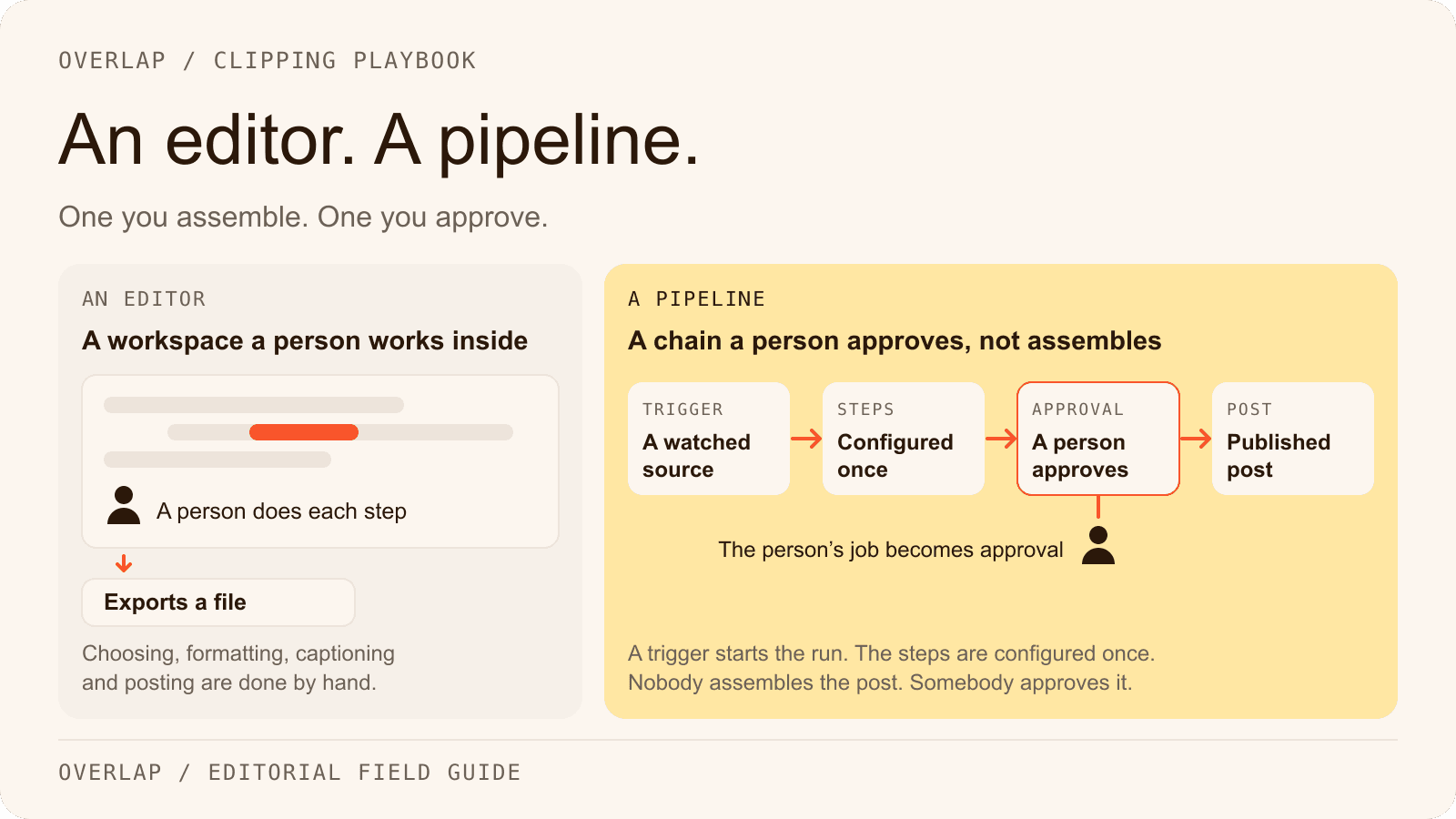
Use Overlap's Find Clips node to select candidates around the decision you want to cover. The prompt controls the editorial request; the Keywords field helps transcription recognize names and specialized vocabulary. It is not a Facebook targeting control.
Here is an original prompt for the hypothetical restaurant interview:
Audience: independent restaurant owners delegating day-to-day shifts for the first time. Find a self-contained explanation of choosing a shift lead before a general manager. Include the reason, a concrete example and any condition that limits the advice. Keep the speaker's actual meaning. Exclude general motivation, sponsor reads and passages that require an unseen chart. If the episode has no complete answer, return no suitable candidate rather than forcing a clip.
Review the resulting boundaries, crop and captions in the production workflow. Overlap's Post to Social node documents Facebook publishing, scheduling and manual approval. It does not document access to viewers' Your algorithm preferences or a way to guarantee recommendations.
Our podcast-to-published-clips walkthrough includes an approved finished example and the review steps. Start with a small batch from recordings the team knows well before applying a new brief across the catalog.
Measure whether the right question reached the right people
Keep a simple ledger: source timestamp, intended viewer, question answered, opening treatment, destination, publication time and observation time. Record the metrics the account actually provides, then read the responses for evidence of comprehension.
Separate comments that ask a useful follow-up from comments that reveal missing context. “How did you define the shift lead's authority?” suggests the example reached someone thinking about the decision. “Who are they talking about?” suggests the edit still needs context. These are editorial signals, not a method for inferring an individual viewer's private interests.
Compare posts at the same age and repeat the approach across several episodes. Record guest reshares, paid promotion and major subject differences. An organic posting sequence cannot isolate the effect of a caption or prove that Your algorithm caused a change in reach.
Use the clip question and audience worksheet to keep those observations beside the brief. If the next batch produces more understandable answers at a manageable review cost, you have evidence of a better production process even before making a claim about distribution.
For Instagram-specific testing, use the separate Trial Reels method. Facebook's new viewer controls do not turn ordinary Facebook posts into Instagram Trial Reels or a randomized experiment.