On this page
Meta One deserves a look from podcast teams that already have a useful destination for their clips. The buying question is whether the features available to your actual account remove enough friction or work to cover their cost. More ways to add a link will not, by themselves, make an episode worth opening.
Start with one destination and one measurable action. A paid membership, an episode page and a sponsor inquiry form have different economics. Treating all three as “traffic” can make an expensive workflow look successful without establishing what it achieved.
What Meta announced for creators and businesses
Meta introduced the service on September 15, 2026, with its announcement updated September 16. The Advanced creator/business plan starts at $49.99 a month and lists links in organic posts and Reels, exportable analytics, deeper insights, team access and advance Story scheduling. Benefits, pricing and availability vary by app, account and region. Edits Plus and its assistant are described as upcoming, rather than features to assume you can use today. Source: Meta One announcement.
Before paying, inspect the offer for the specific account that will publish. Confirm the intended app, format, billing terms and included feature. An agency managing several shows should check this for each client account; a feature available on the agency's own profile does not establish a client's entitlement.
Keep the purchasing decision narrow. If the reason to subscribe is a Reel link, evaluate that link workflow first. Do not assign a speculative value to every other item in the bundle to make the numbers work.
Choose what a click should accomplish
For a podcast, there are at least three sensible destinations. Each needs a different definition of success.
| Destination | Useful next action | What a click cannot establish |
|---|---|---|
| Exact episode page | Start the episode or choose a listening app. | Whether the visitor finished or became a returning listener. |
| Paid membership offer | Complete a purchase tied to the campaign where measurable. | Whether every attributed purchase was caused by this clip. |
| Sponsor or service page | Send a relevant inquiry that enters the sales process. | Whether the inquiry will become a signed, profitable deal. |
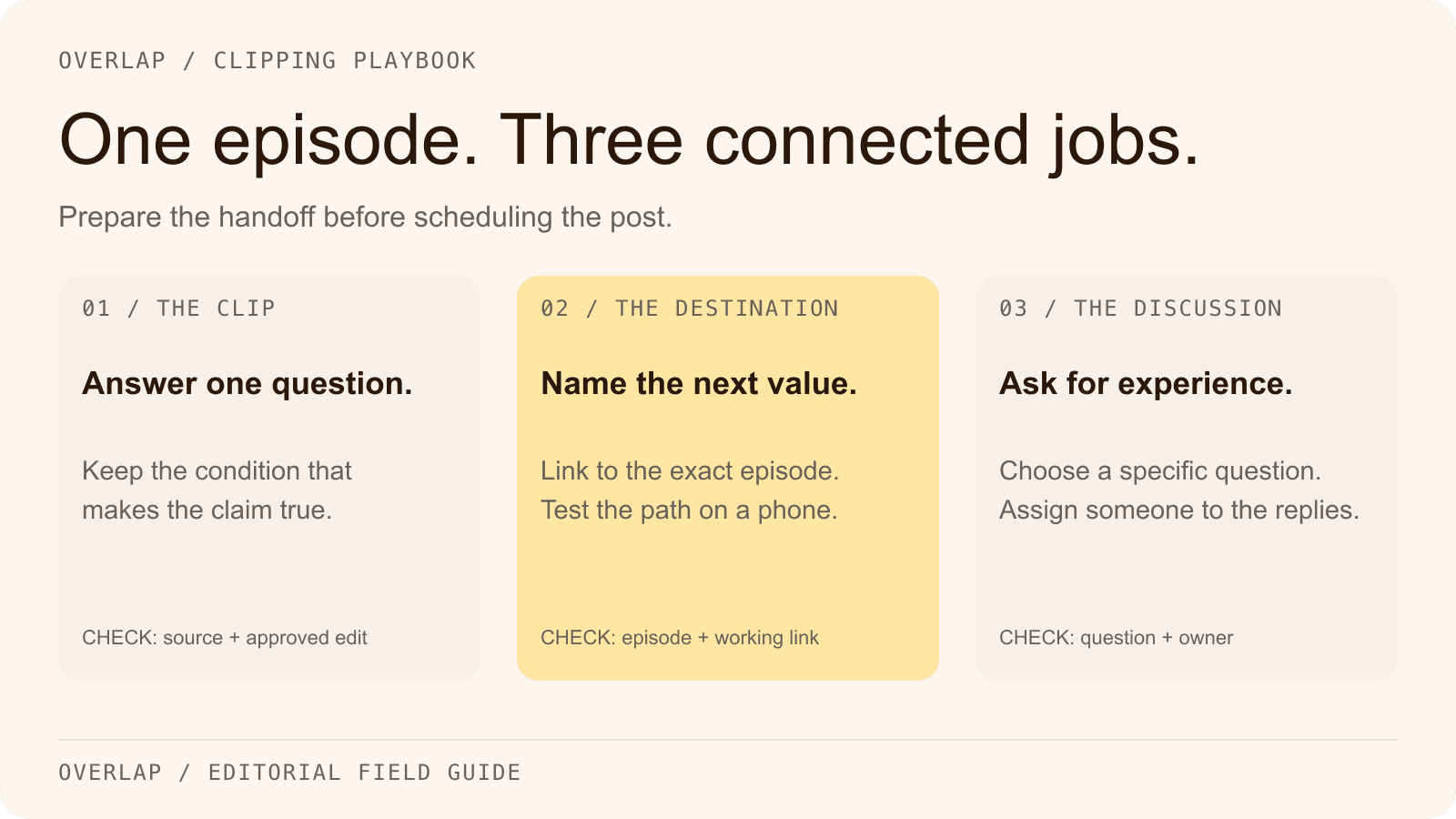
Match the clip to that destination. An excerpt about a guest's hiring process can plausibly lead to the full interview or a related workshop. Sending it to an unrelated subscription pitch asks the viewer to supply a connection the post never made.
The linked page should continue the same promise. Put the episode, resource or offer where a mobile visitor can recognize it immediately. If a listening app opens, test that it resolves to the correct episode. A link that technically works can still deliver the wrong experience.
Calculate the hurdle before running the test
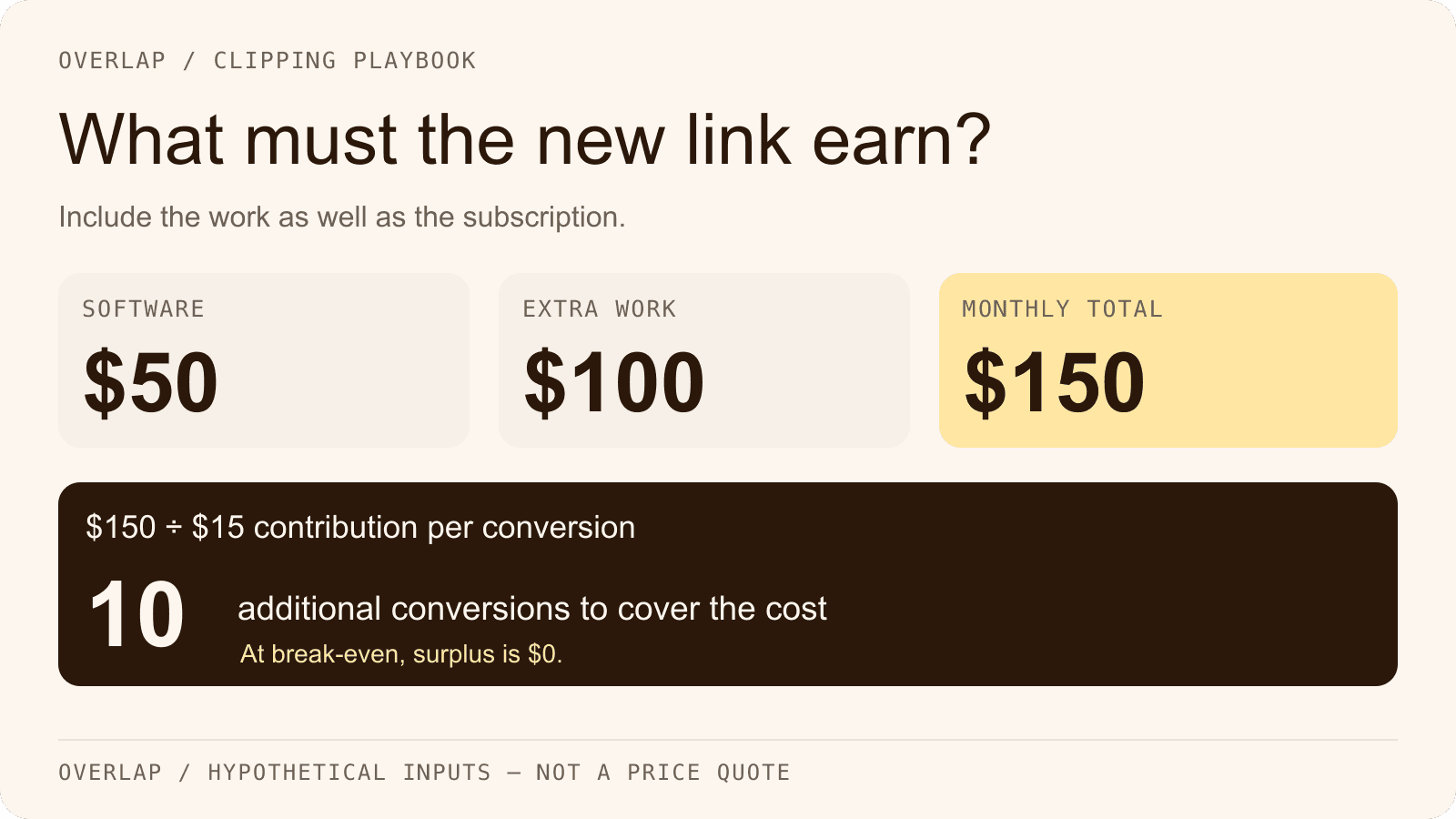
Here is a hypothetical calculation, not a Meta quote or an Overlap customer result. Suppose a team allocates $50 per month for the subscription and $100 for the additional publishing and reporting work. It earns $15 in contribution per incremental conversion, after relevant variable costs, within the chosen evaluation period.
The monthly cost is $150. Dividing $150 by $15 gives 10 additional conversions to break even. At exactly ten, the experiment covers these assumed costs; it has not produced a surplus. If contribution is only $5, the hurdle becomes 30. If there is no credible conversion value yet, report a cost per observable action and keep the revenue conclusion open.

“Incremental” matters. If ten existing members click a Reel and renew as they normally would, that does not establish ten additional purchases. Campaign labels can help associate a transaction with a link; they do not prove what the person would have done without it.
For an audience-growth goal, you may reasonably accept a cost without near-term revenue. State that choice explicitly: a fixed budget to learn whether qualified viewers reach the episode. Avoid converting every click into an imagined future subscriber to claim the experiment paid for itself.
A four-week evaluation you can actually run
Before the first release: confirm account access, choose the destination, define the next action and agree on the cost ceiling. Save the current workflow and results as a reference. Test the destination on a phone and have someone other than its author explain what they are supposed to do there.
During the releases: keep a record of the source episode, post URL, link destination, publishing time, clip angle and review minutes. Use consistent campaign labels on pages you control. Record unrelated boosts, such as a guest sharing the post, so they remain visible during interpretation.
At the weekly review: inspect whether the handoff works. Separate “people did not click” from “people clicked but the destination failed.” Correct broken pages immediately; log the correction so the comparison remains understandable. Do not keep changing the offer, clip format and landing page together without recording what changed.
At the end: compare posts at similar ages and calculate the observable cost and outcome. Ordinary releases are not randomized experiments: topics, guests and distribution vary. Use the result to decide whether to keep testing, change the destination or stop paying for a feature that has not justified its place in the workflow.
The podcast clip review log includes destination, cost and attribution fields. It deliberately leaves room for “unknown,” because an honest missing value is more useful than an invented conversion rate.
How this fits with Overlap and Trial Reels
Overlap's production workflow handles selecting, editing, approving and distributing clips. Its Post to Social documentation includes Instagram as a destination. It does not establish support for attaching Meta One's new native Reel links. Verify that last step in the intended publishing interface and assign one owner to the final post.
You can evaluate a hook separately using the method in our Instagram Trial Reels guide. Keep the questions distinct: which clip earns a relevant response, and whether a paid link workflow creates enough additional value. Do not assume link availability or third-party publishing behavior carries across formats.
If several accounts need the same manual handoff, price that work into the agency scope. Producing a clip, checking a native feature and maintaining its destination take real time even when the video editing is automated.
Who should wait?
A team without a working episode page or a clear offer should fix that first. A team without enough releases to learn from may want to improve its production rhythm before adding another subscription. A team whose main need is reliable clip selection should examine that bottleneck directly.
For teams ready to test, write a one-sentence decision rule before buying: “We will keep this workflow if it produces enough measured value to cover the subscription and additional work, or if the learning is worth the explicitly agreed budget.” Replace “enough” with your own numbers.
That turns a new feature into an accountable experiment. Use Overlap's workflow tools for the production steps and the podcast monetization guide to decide which commercial outcome your next batch of clips is meant to support.