On this page
A podcast clip should give a new listener a complete reason to trust the show. A membership needs a separate reason to pay and stay. Spotify's new Memberships offering makes that distinction worth revisiting: a clip that earns a million curious views can still be a poor introduction to the benefit you sell.
Checked October 22, 2026. Spotify announced Memberships on October 20 and began rolling it out in 34 markets for eligible shows hosted on Spotify for Creators or Megaphone. Benefits can include exclusive audio or video, bonus material and early access; both free and Premium listeners can join. This is a membership launch, not a new payout rate for social clips. Spotify's announcement
Who can set up Spotify Memberships?
Spotify's setup guide lists three published episodes, 100 consumption hours and 100 listeners or viewers on Spotify in the previous 30 days. It says updated criteria apply to shows created starting October 20, while previous Podcast Subscriptions users retain eligibility. Check your show's account and market before planning a launch. Memberships replaces the Podcast Subscriptions name and supports up to three tiers. Setup includes benefits, pricing, payout details and episode access. Eligibility and setup
Eligibility answers whether you can open the door. It does not answer what should be behind it. Before editing a promotional clip, write the recurring benefit in one sentence that a listener could repeat to a friend.
“Support our work” can be an honest invitation. “Every Friday, hear the host work through one listener's pricing problem” is a more concrete production commitment. Choose something the team can deliver during an ordinary busy week, including weeks when a guest cancels.
Give each clip one job
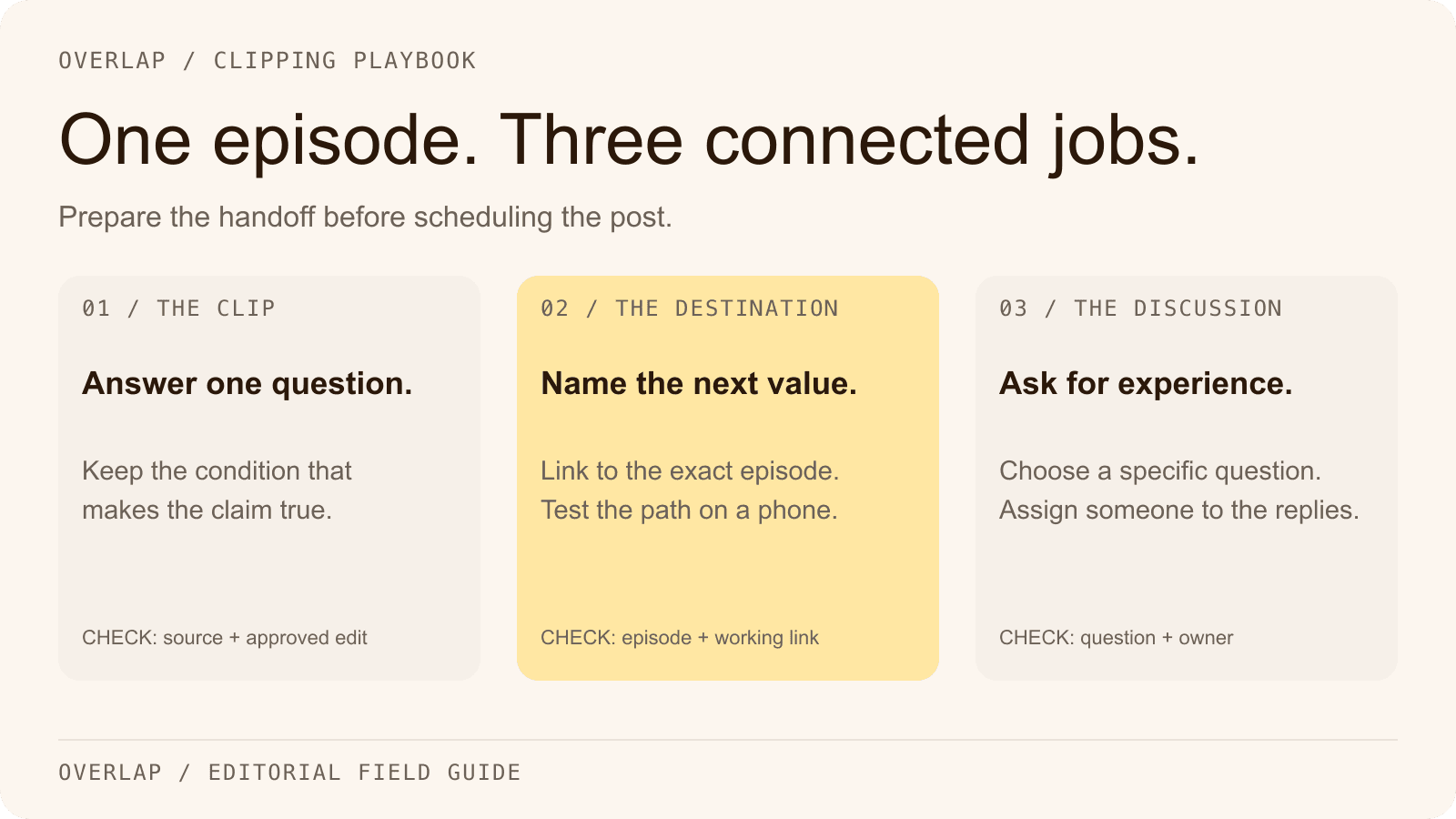
Use three editorial briefs rather than one instruction to find the most exciting moment. The following is an original planning example for a hypothetical business podcast; it is not a customer campaign or a performance prediction.
| Clip | What the viewer gets | What to ask next |
|---|---|---|
| Discovery | A complete answer about a common pricing mistake, including the guest's qualification | Listen to the public episode for the broader discussion |
| Proof | A permitted sample of the host working through a specific decision | Explore the recurring member workshop and its schedule |
| Invitation | The host explains who the membership helps, what arrives next and how often | Review the actual tier and join if it fits |
The proof clip is often the missing piece. A brilliant guest can attract people who have no interest in the host's paid offer. A sample of the recurring benefit helps listeners judge the thing they would actually buy. Obtain permission for any member contribution used publicly, and do not expose private questions simply because they make good clips.
Keep the discovery answer intact. Ending immediately before the useful explanation might drive curiosity, but it gives a prospective member little evidence that the show will deliver. The paid benefit can provide another application, a deeper case study or a recurring service without withholding the promised answer.
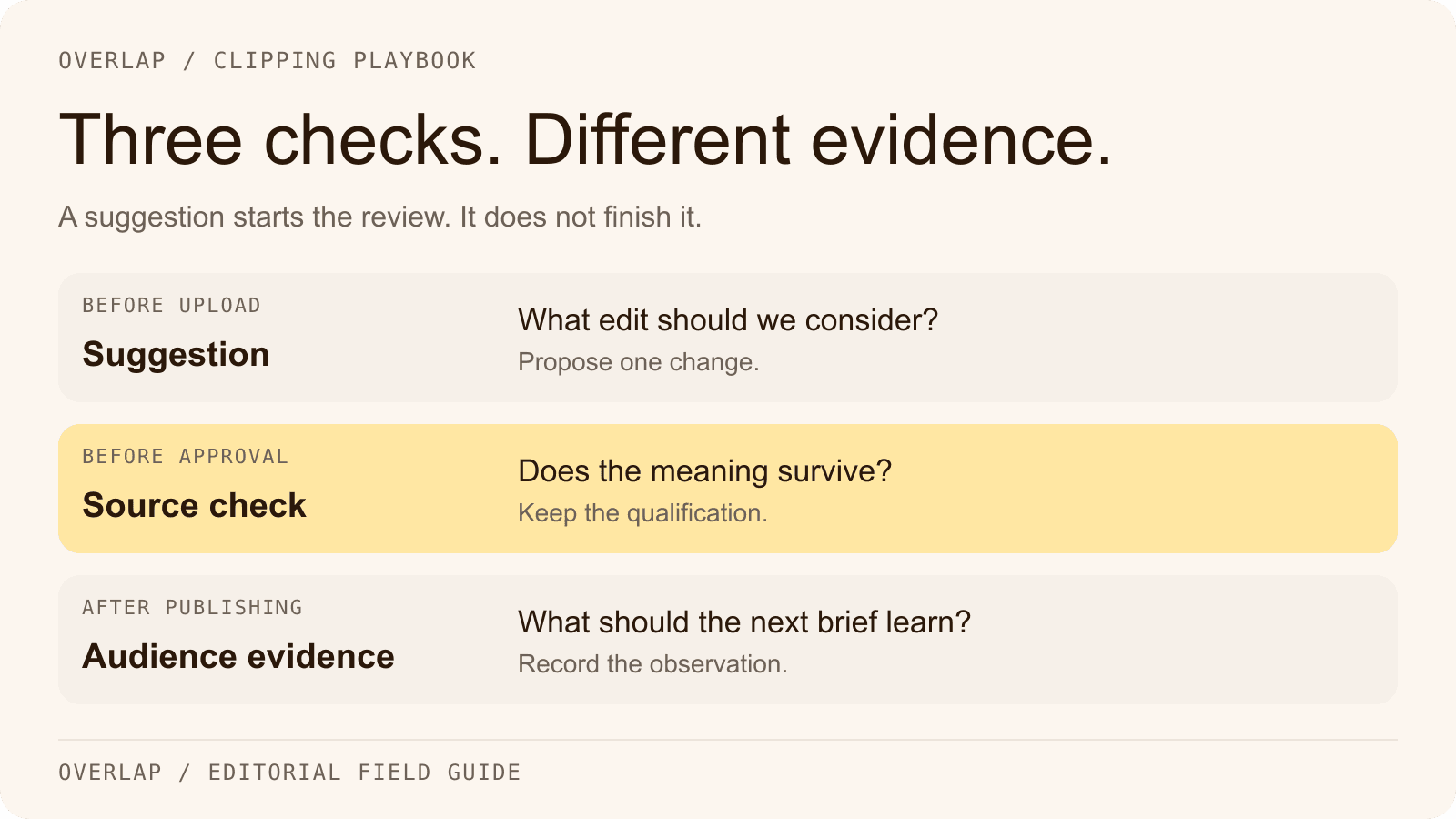
Audit the promise before the call to action
Send every invitation to the tier that matches its wording. If a clip promises a weekly workshop, the destination should explain the cadence, format and first delivery. Have somebody outside the production team follow the path and describe what they think they are purchasing.
Be precise about ads. Spotify's fewer-ads setting removes Spotify-inserted ads for eligible members; it does not remove sponsorships. A host-read sponsor segment can therefore make a blanket “ad-free” promise misleading. Spotify's benefit settings
Keep a small offer ledger with four fields: the clip's exact promise, the destination, the person responsible for delivery and the next review date. Update the invitation when the offer changes. This is particularly useful for agencies managing several shows, where an old caption can outlive the promotion it described.
Measure the people who stay
Use social analytics to understand attention and a tagged landing link, where supported, to understand visits. Those measurements do not automatically identify which viewers become paying members. Record what your tools can actually connect, and leave unattributed joins unattributed.
Spotify's Memberships Performance page includes membership growth, trial conversion, retention and cancellations, with chart exports. Its guidance says data updates every 24 hours. Compare cohorts only after giving them equivalent time to renew. Membership analytics
Consider two hypothetical, equally mature cohorts: one promotion produces 80 joins and 20 members still active at the chosen observation point; another produces 40 joins and 30 still active. The first wins on joins; the second wins on retained members. Neither establishes profitability until you include prices, refunds, production costs and the work of fulfilling benefits. These numbers illustrate a decision, not expected conversion rates.
For a manageable first test, keep the offer and destination fixed while changing the clip's editorial job. Record the publishing date, audience, distribution spend, visits where measurable, joins where attributable and a common retention checkpoint. Do not declare the invitation format superior because it happened to run during a discounted launch.
Build the promotion workflow in Overlap
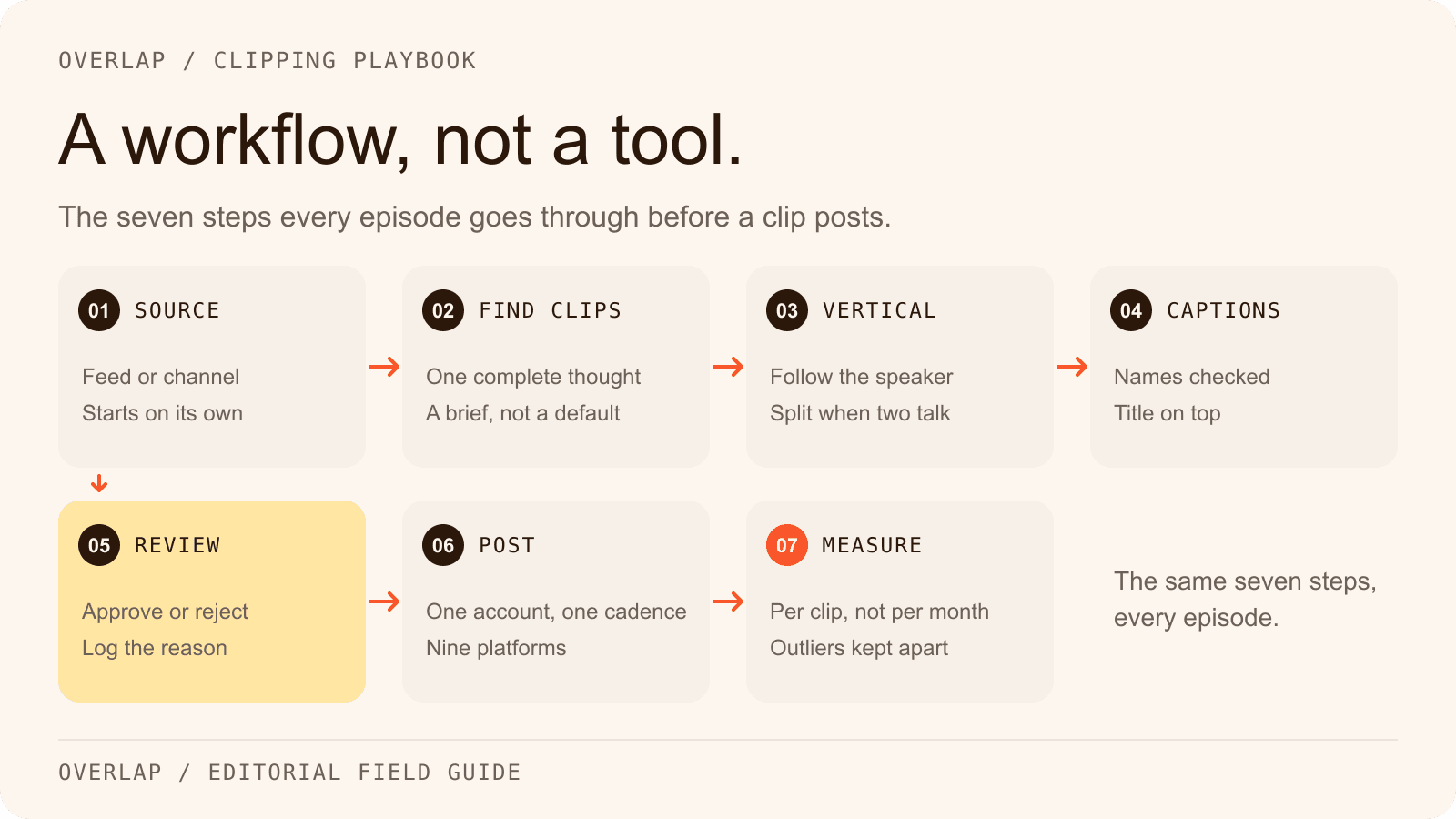
Overlap can help turn approved source episodes into clips and send them toward connected social accounts. Its Post to Social documentation describes choosing the destination account and posting persona. Use the automated clipping workflow to plan source selection, editing, review and publishing.
Write separate selection briefs for discovery and proof. Review the exact cut for context, permission and the offer it implies; check the caption's destination before publishing. Keep member-only source material out of a general-purpose public clipping feed unless you have deliberately approved excerpts for promotion.
Spotify membership administration is a separate task. This workflow does not claim that Overlap creates membership tiers, publishes member-only episodes to Spotify or attributes membership revenue to clips. Use the Post to Social node guide when planning the publishing step.
Use this brief with an editor or adapt it for clip selection:
Find one self-contained answer that demonstrates how this show helps its intended listener. Preserve the reasoning and any caveat. Identify a separate approved moment that demonstrates the recurring member benefit. Flag missing permission or unclear context for human review. Do not invent a benefit, price, deadline or testimonial.
Start with a small batch that the team can review and the membership can fulfill. The useful question after the first cycle is whether new members received the value the clips led them to expect.